
Medium Volatility Slots
Medium volatility slots balance regular hit frequency with meaningful bonus pay-outs, sitting in the middle of the variance spectrum. This 2026 UK guide covers the best titles to play, the maths behind the band, the player profiles it suits, and the misconceptions to ignore.
Medium Volatility Slots Games



Medium Volatility Slots Overview
In technical terms, medium volatility slots are titles where the standard deviation of return per spin sits near the middle of the category-wide distribution — typically a volatility index between 5 and 6 on the 1-to-10 scale most providers publish, with hit frequencies of 20% to 28%, base-game return that contributes meaningfully alongside bonus rounds, and max wins ranging from around 1,000x stake at the conservative end up to 10,000x on the more feature-stacked entries. RTP across the category clusters between 96.0% and 96.7%, sitting close to the regulated-market default, with a small group of titles climbing into the 97% band.
The practical translation is this: across 1,000 spins on a medium volatility slot, you’ll typically see 200 to 280 winning spins, with a meaningful share paying close to or above the original stake. Bonus rounds trigger more often than in higher-variance categories — typically once every 100 to 200 spins — and the bonus contribution to total RTP usually runs between 25% and 35%, leaving the base game to carry a substantial share of return. This balance is what gives medium volatility slots their character: regular, recognisable rhythm without the long dead patches of higher variance or the metronomic small-only wins of lower variance.
Best Medium Volatility Slot Games in 2026
The five titles below were chosen on three criteria: published volatility ratings of 5 or 6 on provider scales (or equivalent third-party verification), max wins between 800x and 5,000x stake to stay clearly within the medium volatility slots band, and active player engagement at UKGC-licensed operators in 2026 rather than legacy popularity. The selection deliberately spans different mechanics — Avalanche, Money Respin, 243-ways, classic 3×3, and progressive Money Collect — because medium variance can be reached through several different game architectures. Every entry has verifiable specs published by the provider.
Gonzo’s Quest
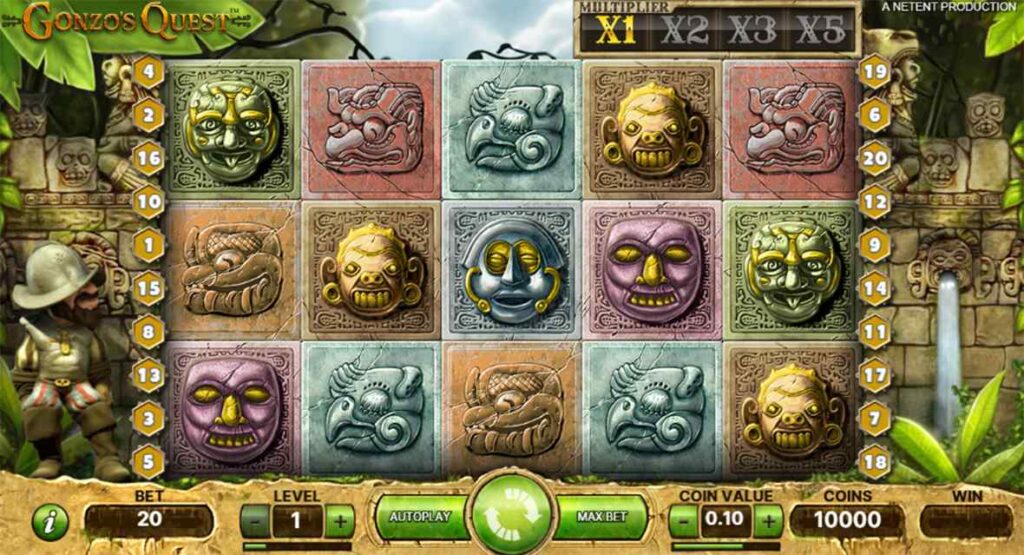
Gonzo’s Quest from NetEnt arrived in 2010 with the Avalanche mechanic that became a genre standard. RTP sits at 95.97%, volatility is medium on the studio’s official rating, the layout is five reels and 20 paylines, and the published max win is 2,500x stake from a £0.20 to £50 spin range. Winning combinations explode and new symbols cascade in, with multipliers stacking to 5x in the base game and 15x in the Free Fall bonus round triggered by three Free Fall symbols on adjacent reels. The hit rhythm in 2026 still defines the category: regular small wins broken up by chained cascades that stack multipliers, with the bonus landing often enough to feel like a proper part of the experience rather than a rare event.
Wolf Gold
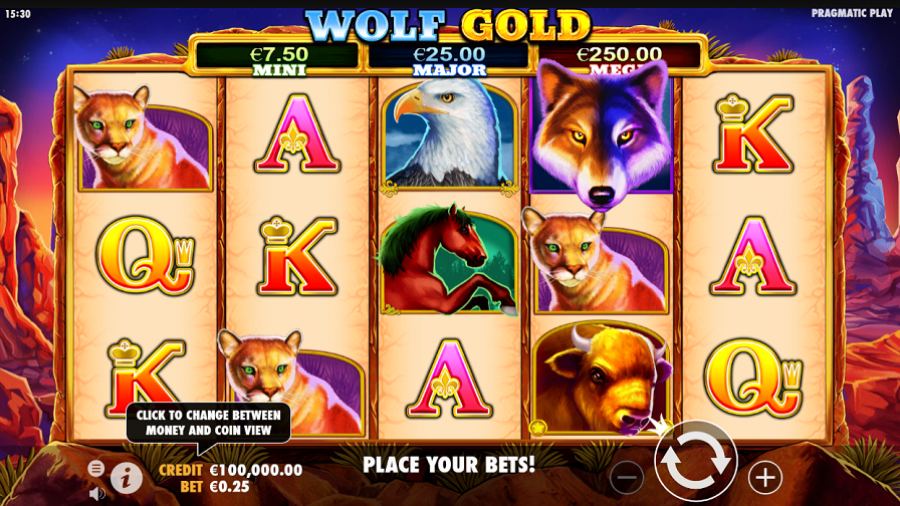
Pragmatic Play released Wolf Gold in 2017 with an RTP of 96.01%, a 5-reel, 25-payline configuration, medium volatility on the studio’s 4-out-of-5 scale, and a published max win of 2,500x stake on the standard pay table plus three progressive jackpots — Mini, Major, and Mega — funded from each spin. Stake range is 25p to £125 per round. The Money Respin feature triggers when six or more money symbols land, granting three respins where each new money symbol resets the counter and full reels of money symbols award the Mega jackpot. The title has remained one of Pragmatic’s most-played releases through three release cycles, and the blend of regular base-game hits with the rare jackpot ceiling makes it one of the cleanest crossovers between standard slots and the jackpot slots category at UKGC operators.
Twin Spin
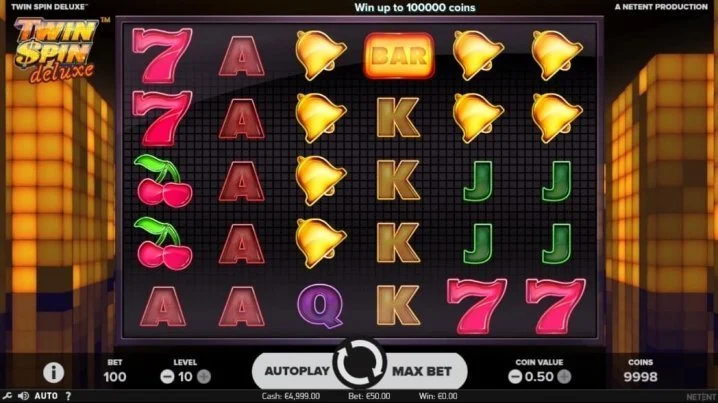
NetEnt’s Twin Spin launched in 2013 with an RTP of 96.55%, a 5-reel, 243-ways-to-win structure, medium volatility on the studio’s official rating, and a published max win of 1,080x stake. Stake range is 25p to £125 per spin. The Twin Reel feature is the entire mechanic: every spin starts with two adjacent reels showing identical synchronised symbols, and through the spin those twin reels can expand to cover three, four, or all five reels — full-reel matches deliver the title’s maximum pay-outs. There’s no traditional bonus round, no free spins, and no multipliers; the Twin Reel feature carries the weight of the variance entirely. The rhythm in 2026 remains distinctive: frequent small wins from the 243-ways structure punctuated by occasional full-reel matches that deliver the headline figures.
Mustang Gold
Pragmatic Play’s Mustang Gold released in 2019 with an RTP of 96.53%, a 5-reel, 25-payline format, medium volatility on the studio’s 4-out-of-5 scale, and a published max win of 1,000x stake. Stake range is 25p to £125 per spin. The Money Respin feature mirrors the Wolf Gold mechanic — six or more money symbols trigger three respins where new money symbols reset the count and a full screen awards the Grand Jackpot. The Free Spins round, triggered by three or more bonus scatters, grants eight free spins with all wins multiplied. The hit rhythm in 2026 is steady and predictable, the Money Respin lands often enough to feel like a regular feature rather than a rare event, and the title is one of the cleanest entries for UK players who want the Pragmatic Money Collect mechanic in a medium-variance package.
Fire Joker
Play’n GO’s Fire Joker arrived in 2016 with an RTP of 96.15%, a 3-reel, 5-payline classic-fruit format, medium volatility on the studio’s official rating, and a published max win of 800x stake. Stake range is 5p to £100 per spin. The Respin of Fire feature triggers whenever two of the three reels show matching symbols, granting one respin on the remaining reel. The Wheel of Multipliers activates when the entire reel set fills with identical symbols, awarding multipliers from 2x to 10x. There’s no traditional free-spin bonus, and the title’s compact structure delivers a session rhythm that feels closer to a classic fruit machine than to a modern feature-stack release. UK players who want medium variance without the visual complexity of newer titles tend to keep Fire Joker in regular rotation through 2026.
How Medium Volatility Slots Work
The volatility of any slot is calculated from the standard deviation of return across simulated spins — providers run millions of rounds during certification and measure how widely outcomes spread around the expected RTP. A medium-variance title produces a return distribution where the spread between session outcomes is moderate: most sessions return within 30% of the published RTP either way, compared to 50%-plus deviations on high variance and 15% deviations on low variance. The maths is built around a balance between base-game frequency and bonus-round contribution, and that balance is what defines the category.
Hit frequency derivation matters here. Medium volatility slots pay a winning combination on roughly 20% to 28% of spins — meaning a meaningful share of base-game spins return some value, with a smaller share returning more than the original stake. Bonus frequency in this category typically lands between 1 in 100 and 1 in 200 spins, which is roughly twice as often as high-variance titles and half as often as low-variance ones. None of this is hidden — providers publish volatility ratings, and operators must publish RTP for every slot they deploy under UKGC rules in 2026.
SpinHunter’s review and refresh cycle for medium volatility slots in 2026 evaluates titles quarterly. Triggers for re-evaluation include provider RTP changes documented at recertification, displacement by new releases that hold up over engagement metrics, or any reported variance discrepancy between certified and deployed builds. Titles that drift outside the medium band on third-party verification are reclassified rather than removed. We track new slots separately for releases too recent to have stable engagement data.
Key Characteristics of Medium Volatility Slots
UK players spinning medium volatility slots in 2026 should expect a few consistent traits. Hit frequency runs from 20% to 28% across titles in the category — meaning roughly one in four spins delivers a winning combination of some size. Of those wins, a meaningful share pay more than the original stake, with the upper band of pays typically clustered in the bonus round or feature trigger. Max wins range from around 800x stake on the most measured entries up to 5,000x on the more feature-stacked releases, with occasional outliers reaching 10,000x on titles that blur the line into medium-high territory. Stake ranges run from 5p to £125 per spin across the major releases.
Device compatibility is universal in 2026. Every medium-variance title from a serious provider runs in HTML5, loads in any modern browser without a plugin, and supports both landscape and portrait orientations on phones with touch controls mirroring the desktop button layout. Performance on mid-range Android and iPhone hardware is functionally identical to desktop for any major release in the past decade. The visual demands of cluster-pay or cascade titles are higher than for classic 5×3 layouts, but the difference rarely surfaces as a meaningful issue on hardware released within the last three years.
Session length implications matter most in this category because medium variance is the band where typical UK session planning maps most cleanly. A bankroll of £100 spun at £1 per round on a 96% RTP medium-variance title typically lasts 95 to 130 minutes — close to the published RTP-derived expectation, with variance bands narrower than higher-variance equivalents. Sessions of 200 to 400 spins are usually long enough to see one or two bonus triggers and a representative slice of the title’s rhythm, which is part of why this category remains the default for UK players who want predictable session profiles.
Common Misconceptions About Medium Volatility Slots
The first misconception about medium volatility slots is that they’re the safe middle option that delivers something between low and high variance on every session. The maths doesn’t work that way. Medium variance describes the long-run distribution shape, not the session-level experience. Any individual session can swing dramatically — a £100 bankroll on Wolf Gold can collapse in 25 minutes without a Money Respin trigger, or stretch past three hours on the back of two productive bonus rounds. The category averages out to predictable returns over thousands of spins, but no single session is guaranteed to land near that average.
The second is that medium-variance titles deliver smaller max wins than high-variance ones across the board. That’s only partly true. The category’s max wins do cap lower on average — typically 1,000x to 5,000x stake compared to 5,000x to 50,000x on high variance — but the gap closes considerably on the feature-stacked end of medium variance, where Bonanza Megaways and similar titles deliver max wins of 10,000x and beyond. Players choosing a title on max win alone often miss that the practical achievable wins on a medium-variance slot can match or exceed the rare ceilings on a more punishing high-variance entry, simply because the bonus triggers more often. We cover the trade-off in detail in our high volatility slots guide for direct comparison.
The third is that bonus features on medium-variance slots are watered-down versions of high-variance equivalents. They aren’t. The same providers ship the same feature mechanics — free spins, multiplier rounds, money respin, expanding wilds — across both volatility bands, with the difference being how often the trigger lands and how the reward is distributed within the round. A medium-variance free-spin round can deliver the same maximum pay-out as a high-variance one; what differs is the probability distribution of where in that range the typical round lands.
How to Choose the Right Medium Volatility Slots for You
The low-budget casual UK player — bankrolls under £50 a week, sessions of 15 to 30 minutes — is well-served by medium volatility slots because the band’s hit frequency keeps the bankroll moving without the long dry stretches of higher-variance titles. Stake at 10p to 25p per spin on a £20 weekly slot budget across titles like Fire Joker, Twin Spin, or Gonzo’s Quest, and the maths delivers 80 to 200 spins per session depending on bet size. The category’s rhythm makes sustained low-stakes sessions more entertaining than equivalent volume on high variance, where the dead-spin frequency erodes engagement faster than the bankroll erodes by RTP alone.
The mid-stakes regular — sessions of 45 to 90 minutes, weekly bankrolls in the £100 to £400 range, comfortable with £1 to £5 stakes — is the natural audience for the category. A £200 bankroll spun at £1 to £2 per round delivers 100 to 200 spins, which is enough volume for two to four bonus triggers across the visit and a representative slice of variance behaviour. Wolf Gold and Mustang Gold sit comfortably in this bracket. Mid-stakes regulars should also confirm the operator’s deployed RTP version matches the published certification before each session, since some operators run lower variants under separate licence.
The high-roller bankroll player — sessions over two hours, weekly bankrolls of £1,000 plus, stakes from £5 to £100 per spin — uses medium variance for predictable session profiles rather than ceiling chasing. At £10 per spin on a 96.5% RTP title, the variance band on a 200-spin session is wide but recoverable across the volume the profile typically plays. Strategy at this stake level focuses on game selection that favours top-band RTP within the category, which we cover further in our real money slots guide.
Tips and Strategy for Playing Medium Volatility Slots
The first useful principle is bankroll-relative bet sizing. The standard rule for medium volatility slots is to stake at 0.5% to 2% of session bankroll per spin — meaning a £100 bankroll spins at £0.50 to £2.00 per round. This buys volume without burning the bankroll before the bonus has a chance to land, and the band’s hit frequency means smaller stakes still deliver enough engagement to feel like a proper session rather than an endurance test. Players who stake at 5% of bankroll per spin in this category typically end the session before the bonus contribution to RTP has a chance to surface.
The second is the case for demo-first play. Spin 100 to 300 demo rounds on any medium-variance title before committing real cash. The point isn’t to learn patterns — there are none — it’s to confirm whether the title’s specific rhythm suits your tolerance. The category contains substantial variation: Twin Spin and Fire Joker run closer to low-medium, while Big Bass Bonanza and Bonanza Megaways drift closer to medium-high. Demo testing tells you which end of the band a title actually sits at, regardless of the published rating.
The third is session limit discipline. Set a real-money bankroll before the session, set a hard loss cap at 30% to 50% of that bankroll, and walk away when either fires. UKGC operators in 2026 are required to display loss alerts during play and to provide deposit limits, time-outs, and reality checks in account settings before you spin a single round. There are no patterns or hot or cold periods in medium variance any more than in any other category — every spin is independent, and the only variable you control is when you stop.
Leading Providers for Medium Volatility Slots in 2026
NetEnt continues to define the category in 2026 through Gonzo’s Quest, Twin Spin, and the studio’s broader catalogue of medium-variance releases that ship at the band by default rather than as deliberate variance positioning. Pragmatic Play holds the largest market share through Wolf Gold, Mustang Gold, and the wider Money Collect family — all of which sit at 4-out-of-5 on the studio’s volatility scale, equivalent to medium across the regulated UK market. Play’n GO contributes Fire Joker, Reactoonz, and a sustained pipeline of medium-variance releases that track engagement well at UKGC operators across 2025 and into 2026. Big Time Gaming sits at the medium-high end with Bonanza Megaways and several Megaways follow-ups, where the variance comes from the dynamic reel structure rather than a traditional payline configuration. Yggdrasil delivers Vikings Go Wild and Holmes and the Stolen Stones in the upper-medium band. Microgaming rounds out the category with Immortal Romance and Thunderstruck II — both of which carry medium variance ratings and remain consistent picks among UK players who prefer narrative-driven titles to abstract modern stylings.
Medium Volatility Slots vs Related Slot Types
The category sits in the middle of the variance spectrum between the steady rhythms of low variance and the patience-defined runs of high variance. Direct comparison with adjacent volatility tiers makes the trade-offs explicit. The axes that matter for that comparison are the volatility rating, the typical hit frequency, the max win range, and the session profile that suits each tier. The table below summarises those four axes side by side.
| Slot Tier | Volatility Rating | Hit Frequency | Max Win Range | Session Profile |
|---|---|---|---|---|
| Low volatility | 1–4 / 10 | 25%–35% | 500x–2,500x | Long, steady, frequent small wins |
| Medium volatility | 5–6 / 10 | 20%–28% | 1,000x–10,000x | Balanced rhythm, regular bonus triggers |
| High volatility | 7–9 / 10 | 15%–22% | 5,000x–50,000x | Patience-heavy, bonus-defined |
| Very high volatility | 9–10 / 10 | 12%–18% | 50,000x–150,000x+ | Punishing dry runs, extreme ceilings |
The table makes the trade explicit: this category sits at the volume-friendly midpoint where hit frequency and max win range balance against each other rather than one dominating. The session profile is the most distinguishing trait — players in this band see a recognisable rhythm of base-game wins broken up by regular bonus rounds, without either the metronomic pace of low variance or the long dead patches of high variance. UK players evaluating where they fit should also consider the low volatility slots tier directly below for sessions where steady frequency matters more than ceiling.
Where to Play Medium Volatility Slots at UK Casinos
Before you deposit, verify the operator. Every UK-facing casino must hold a current UK Gambling Commission licence — that’s verifiable on the UKGC public register, where the licence number printed in the casino’s footer must match an active record. The casino’s help panel should also publish RTP for every slot it deploys, since some operators run multiple RTP versions of the same title under separate certification. The 95.97% Gonzo’s Quest and lower-RTP variants are both legal builds — only the operator’s published figure tells you which one sits on their server. We compile best RTP slots data across operators specifically to make this verification easier.
The April 2026 UKGC rule set then applies once you cross from demo into real money. Bonus wagering caps at 10x the bonus value, the maximum bet during any bonus play is £5 per spin or hand regardless of the cash stake limit on the title, mandatory loss alerts must display when net loss thresholds are reached during a session, and the 2021 bonus-buy ban remains in force on every UKGC-licensed slot — meaning no title legally available to UK players can offer a feature-buy button, regardless of what the demo on the provider’s site might show. The bonus-buy rule affects medium volatility slots less than higher-variance categories, since the trigger frequency in this band is moderate enough that paying for the bonus would offer little advantage even if it were legal.
Responsible Gambling
UKGC operators in 2026 are required to provide a full set of in-account responsibility tools to every UK player. Deposit limits can be set daily, weekly, or monthly and apply across the operator’s network within their licence. Reality checks display elapsed session time and net profit or loss at intervals you control. Time-outs lock the account from 24 hours up to 6 weeks. Self-exclusion at the operator level prevents account access for a fixed term you choose. These tools are configurable before you make your first cash deposit and remain accessible throughout your relationship with the operator.
External support exists when operator-level tools aren’t enough. GamStop is the UK’s national self-exclusion scheme, blocking access to every UKGC-licensed gambling site for a chosen period of six months, one year, or five years across the entire network. GamCare provides counselling and a live helpline on 0808 8020 133 with seven-day support, reaching trained advisers for confidential discussions. BeGambleAware operates the awareness side, providing information, treatment referrals, and self-assessment tools for anyone wanting to evaluate their own gambling behaviour without yet committing to support. 18+ Please gamble responsibly.

50 Free Spins No Deposit
Claim BonusT&Cs Apply. 18+ New players only. Min deposit £10.

30 Free Spins No Deposit
Claim BonusT&Cs Apply. 18+ New players only. Min deposit £10.

20 Free Spins + £10 Bonus
Claim BonusT&Cs Apply. 18+ New players only. Min deposit £5.

100 Free Spins No Deposit
Claim BonusT&Cs Apply. 18+ New players only. Min deposit £10.

25 Free Spins No Wagering
Claim BonusT&Cs Apply. 18+ New players only. Winnings paid as real cash.




30 Free Spins No Wagering
Claim BonusT&Cs Apply. 18+ New players only. Winnings paid as real cash.

50 Free Spins No Wagering
Claim BonusT&Cs Apply. 18+ New players only. Winnings paid as real cash.
* 18+ only. New customers only. T&Cs apply. Gamble responsibly.
* 18+ only. New customers only. T&Cs apply. Gamble responsibly.