
Low Volatility Slots
Low volatility slots return frequent small wins rather than rare large ones, suiting players who want long sessions on modest bankrolls. This SpinHunter 2026 guide covers verified UK-available titles, the maths behind variance, and how to choose by stake and session goal.
Low Volatility Slots Games



Featured Casinos

Velobet
50 Free Spins + £10 Bonus


 Accepted payments

Zizobet
50 Free Spins No Deposit
Accepted payments

Cosmobet
50 Free Spins No Deposit
Accepted payments

Rolletto
50 Free Spins No Deposit
Accepted payments








* 18+ only. New customers only. T&Cs apply. Gamble responsibly. BeGambleAware.org
Low Volatility Slots Overview
A low-variance slot, in the working definition most UK reviewers apply, is a title whose payout distribution favours frequency over scale — typically scoring 1 or 2 on a 1–5 internal volatility index used by major studios, hitting paying combinations roughly once every 2.5 spins or better, and capping maximum win below the 5,000x stake threshold that separates moderate from genuinely volatile titles. Most low volatility slots at UKGC-licensed casinos in 2026 sit comfortably between 500x and 2,500x for their published max-win ceiling.
The variance metric isn’t always disclosed in numerical form. NetEnt publishes a 1–10 internal score, Pragmatic Play uses a five-tier label, Play’n GO discloses qualitative ratings inside game documentation, and several smaller studios omit it entirely. Where the figure isn’t published, third-party reviewers reconstruct it through observed hit-frequency sampling and standard-deviation analysis across thousands of demo spins. Treating a “low” variance tag as standardised across providers misreads the category — Pragmatic’s low entries differ meaningfully in feel from NetEnt’s.
Where the maths becomes practical is expected session length per pound staked. A 96% RTP low-variance slot at 20p stakes typically delivers 60–90 minutes per £20 deposited, against 20–40 minutes on a high-variance title at the same stake and bankroll. That spread is the entire point of the category.
Best Low Volatility Slots in 2026
The shortlist below was assembled by cross-checking certified RTP figures against provider documentation, SlotCatalog records, and independent reviewer data, then filtering for verified low-variance classifications and 2026 UK availability at UKGC-licensed operators. Every title hits paying combinations frequently enough to sustain 30–60 minute sessions on £20–£40 bankrolls. Treat this as a starting shortlist of low volatility slots rather than a strict ranking — fit depends on theme preference and stake range as much as on headline figures.
Starburst
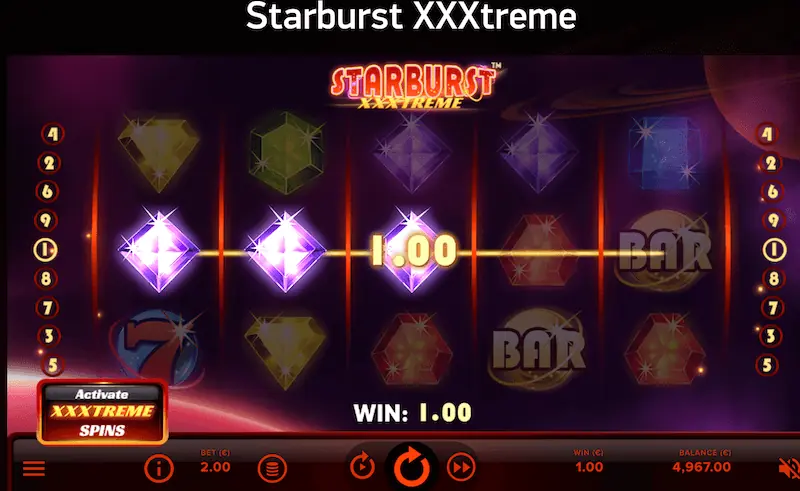
NetEnt’s Starburst released in 2012 with a 96.09% RTP, a 5×3 grid, ten bidirectional paylines, and a low-variance profile capped at 500x maximum win. The space-jewel theme runs over polished sound design that’s barely aged, and the wild-respin mechanic — expanding wilds locking on reels two, three, and four for up to three respins — sets a hit rhythm that stays consistently active. Hit frequency clears 41% on standard deployments, which translates to a paying spin every 2.4 spins on average. It suits players who want a low-stress entry point to the category, with bankroll endurance prioritised over ceiling potential. The 500x cap is the obvious limitation, but it’s also why sessions on Starburst stretch further than almost any title in the modern catalogue.
Blood Suckers

Blood Suckers from NetEnt is a 2009 release that pairs a 98% certified RTP — a figure that puts it on nearly every list of high RTP slots at UK casinos — with a low-variance profile and a 900x maximum win. The 5×3 grid runs twenty-five paylines and three sequential bonus features: a vampire-themed bonus game, a free-spins round with a 3x multiplier, and frequent base-game pays that keep the bankroll moving. Hit frequency sits around 38%, marginally below Starburst, but the lower house edge offsets the gap measurably across longer sessions. The horror theme is dated by 2026 standards, but the underlying maths remains genuinely competitive. It’s the strongest pick on this list for players prioritising long-run value over visual polish.
Starmania
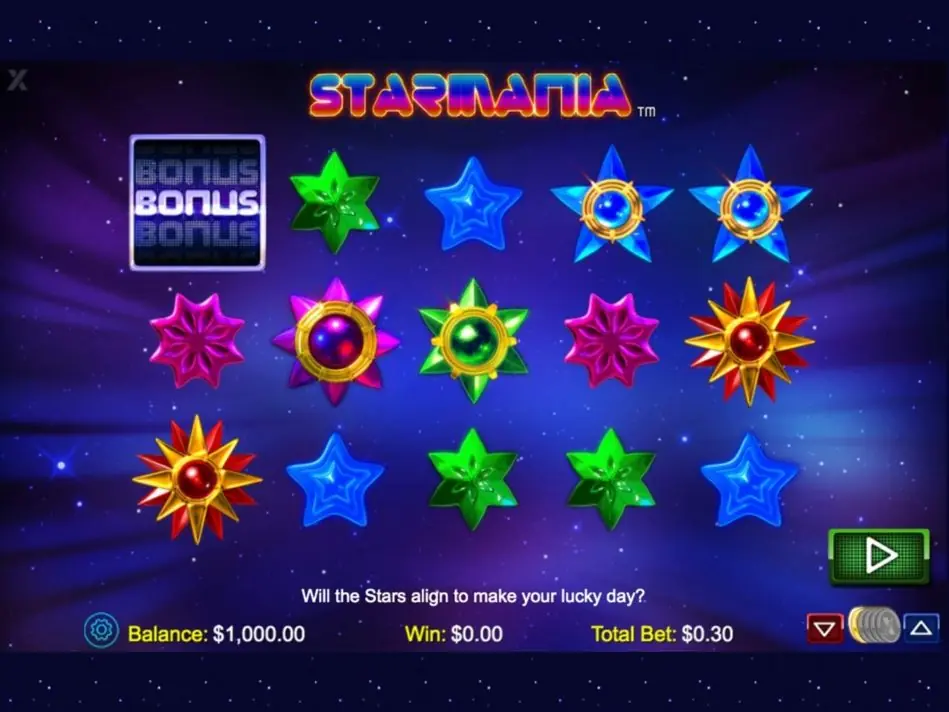
Starmania from NextGen Gaming launched in 2012 with a 97.87% certified RTP, a 5×3 grid, ten bidirectional paylines, and a low-variance profile that caps at 2,400x maximum win — comfortably the highest ceiling in this list. The neon-galaxy theme keeps the visual register restrained, and an expanding-wild mechanic during free spins drives the larger payouts. Free spins trigger from three or more scatter symbols and can re-trigger inside the round. Hit frequency clears 43%, the highest in this shortlist, which makes it one of the most session-friendly low volatility slots for cautious bankroll management. The disappointment for some will be the muted theme — the visual energy doesn’t match the variance generosity — but mechanically it punches well above its weight.
Aloha Cluster Pays
Aloha Cluster Pays from NetEnt released in 2016 with a 96.42% certified RTP, a 6×5 grid, cluster-pays mechanic, and a low-variance profile designed around frequent cluster formations rather than payline hits. The Hawaiian theme runs over a sticky-win re-spin mechanic where winning symbols hold while non-winning positions respin, and a free-spins round triggers from three scatters with a symbol-substitution feature that boosts cluster sizes. Hit frequency on cluster slots reads differently from payline titles — the metric counts cluster formations rather than line wins — but the practical effect is paying activity on roughly 38–42% of spins. The visual identity is stronger than the older entries above, which matters for sessions where presentation drives engagement.
Lucky Larry’s Lobstermania 2
Lucky Larry’s Lobstermania 2 from IGT is a 2014 online release with a 96.52% certified RTP, a 5×4 grid, forty paylines, and a variance profile inherited from its land-based predecessor that sits at the lower end of the spectrum on most reviewer scales. The seaside-comedy theme — loud cartoon lobsters, beach-shack soundscape — divides players sharply, but the maths is consistent: hit frequency around 40%, max win around 1,000x stake, and a Buoy Bonus pick-me round that triggers reliably enough to factor into session expectations. The forty paylines mean modest-stake players can run 40p–50p spins without exposing the bankroll on every cycle. It’s the most overtly casual entry on this list.
How Low Volatility Slots Work
Volatility is a statistical property of a slot’s payout distribution rather than a setting providers can adjust. It’s calculated during certification by measuring the standard deviation of returns across a simulated million-spin sample — the wider the spread between high-payout and low-payout outcomes, the higher the volatility rating. Low volatility slots compress that distribution: the symbol pay tables weight smaller wins heavily, the bonus features pay frequently rather than scarcely, and the maximum-win cap stays well under the four-figure-multiplier mark. The certified RTP can be identical between a low-variance and a high-variance title, but the path to that long-run figure differs sharply.
For UK-deployed low volatility slots, providers publish the variance classification through internal scoring systems and third-party reviewers verify it through observed hit-frequency sampling. SpinHunter’s 2026 methodology requires at least 200 demo spins per title at a fixed stake before classifying variance, with classification re-verified annually as providers occasionally adjust paytables in updated game versions. The classification is not a UKGC requirement — operators must publish RTP, not volatility — so the figure you see in reviews comes from voluntary disclosure or independent measurement.
Where the maths becomes useful is bankroll planning. Expected session length on a low-variance title with a 96% RTP and 40% hit frequency at 20p stakes runs roughly 60–80 minutes per £20 staked before depletion to break-even or worse. The same bankroll on a high-variance equivalent might burn through inside 25 minutes despite identical headline RTP, simply because the payout distribution back-loads returns into infrequent large hits.
Key Characteristics of Low Volatility Slots
Hit frequency in this category clusters between 35% and 48%, depending on the specific title and how cluster-pays mechanics are counted. Starburst hits 41%, Blood Suckers 38%, Starmania 43%, and most NetEnt low-variance entries cluster in that band. The practical effect is a paying spin roughly every 2.2 to 2.8 spins, which keeps the screen lit and the bankroll ticking. Maximum-win ranges run from 500x at the conservative end to 2,400x at the upper end, with most low-variance staples landing between 800x and 1,500x. That ceiling sits meaningfully below medium volatility slots, which routinely cap at 5,000x–10,000x.
Stake ranges typically run from 10p to £100 per spin on UKGC deployments, with most regulars settling at 20p–50p stake levels because the lower variance rewards higher spin volume rather than fewer high-stake spins. Bet structures are usually fixed-payline rather than ways-based, with a few cluster-pays exceptions. Device compatibility is universally strong — every modern low-variance release runs on iOS and Android browsers without app downloads, and accessibility features like reduced-motion modes and screen-reader support are increasingly standard on 2026 deployments.
Session-length implications skew long. The defining trait of low volatility slots is that the maths supports 30–90 minute sessions on £20–£50 bankrolls without abrupt depletion, which is why the category dominates casual play and post-work entertainment use cases. Players treating slots as priced entertainment rather than payday gambits get the most measurable value here, because the cost-per-minute curve flattens against any volatile alternative at the same RTP. The practical consequence is that you’ll see the bonus round more often, trigger free spins more reliably, and end sessions closer to the headline RTP figure than on a higher-variance equivalent.
Common Misconceptions About Low Volatility Slots
The first misconception about low volatility slots is that the variance label translates to low maximum win. Several entries in the category cap at 2,000x or above — Starmania at 2,400x is the obvious example, and titles like Mega Joker theoretically reach far higher when supermeter mechanics engage. The variance rating describes payout distribution, not ceiling potential. A slot can deliver frequent small returns and still preserve a four-figure-multiplier ceiling on the rare bonus-round combinations. Players who skip the category assuming the upside doesn’t exist consistently miss titles where the maths supports both attributes simultaneously. The 500x cap on Starburst isn’t a category trait; it’s a Starburst trait.
A second misconception is that low volatility slots are tedious or that the lower ceiling translates to less engagement. Engagement isn’t a function of max-win potential — bonus-trigger frequency, the stickiness of feature mechanics, and the cluster-pays variations across the category produce session textures that map differently to player profiles than high-variance titles. A player who finds a 200-spin dry stretch on a volatile slot tedious will rate the same session length on a low-variance equivalent as engaged simply because paying activity returns every two to three spins. The category’s reputation for tedium tends to come from players staking too high relative to bankroll.
A third misconception is that the headline RTP carries less weight in this category because session-level results are smoother. The opposite is closer to true. Because low volatility slots return closer to their headline figure inside any given session, the difference between a 95% deployed variant and a 98% certified maximum is more visible to the player rather than less. On high-variance titles, a single bonus round can swing session results far enough that the underlying RTP gap is invisible across a few thousand spins. On low-variance titles, that same gap shows up consistently across the cost-per-minute curve.
How to Choose the Right Low Volatility Slots for You
Low-budget casual players working with a £15–£40 weekly bankroll get the most natural fit with low volatility slots. At 10p–20p stakes, a £20 deposit on Starburst or Lucky Larry’s Lobstermania 2 routinely sustains 60–90 minute sessions, with several bonus-round triggers across the window and bankroll depletion that arrives gradually rather than abruptly. The session goal here is entertainment density per pound, not chasing top-end multipliers, so the lower-ceiling entries on this list (Starburst, Blood Suckers) match cleanly. Stick to stake sizes that allow at least 200 spins per session deposit, and avoid the temptation to bet up after a dry stretch.
Mid-stakes regulars working with a £100–£300 monthly bankroll benefit from splitting bankroll across two or three titles within the category, balancing the higher-RTP entries (Blood Suckers at 98%, Starmania at 97.87%) with the more visually engaging cluster-pays options (Aloha Cluster Pays). At 30p–80p stakes, session lengths run 45–75 minutes on £30 deposits, with bonus rounds triggering frequently enough that you’ll see the feature maths play out across most sessions. Set per-session stop-loss limits at 30–40% of session budget, and run free demo slots versions before committing real-money bankroll to any new release in the category.
High-roller players staking £5+ per spin will find the category less natural than mid-variance or volatile alternatives, simply because the lower max-win ceiling caps single-spin upside. That said, the lower house edge does compound at scale — a 98% RTP low-variance slot at £10 stakes carries an expected loss of £20 per £1,000 wagered against £50 on a 95% RTP title. The session strategy here is to use low volatility slots as a bankroll-preservation phase between higher-variance sessions, not as the primary entertainment vehicle.
Tips and Strategy for Playing Low Volatility Slots
Bet sizing should track session bankroll rather than headline RTP. The standard discipline is to stake at a level that gives at least 150 spins per deposit — on a £30 session bankroll, that translates to 20p stakes on Starburst or 15p stakes on Aloha Cluster Pays. The frequent-pay rhythm of low volatility slots masks bankroll erosion if stakes drift upward, so set the per-spin stake at session start and avoid adjusting it during play. Treating the lower variance as license to bet up is the most common mistake players make in this bracket, and it neutralises the category’s structural advantages.
Demo play matters here for a different reason than in volatile categories. Most UKGC-licensed operators offer free-play modes, and 200–300 demo spins on any new low-variance title reveal the actual hit frequency, the bonus-trigger pacing, and whether the deployed RTP variant matches the certified maximum. The demo balance behaves identically to real-money play for variance and hit-frequency purposes, so it’s a clean diagnostic. Run demo sessions on mobile slotsdeployments specifically if you’ll do most real-money play on phone, since rendering and animation timing can subtly change session feel between desktop and mobile clients.
Session limits and loss caps still matter, even though smoother variance reduces the need for them in absolute terms. Set deposit limits at the operator level, schedule reality-check intervals at 30 or 60 minutes, and walk away when a session-loss cap hits regardless of how favourable the long-run maths appears. The category’s tempo encourages longer sessions, which can offset the variance advantage if cumulative wager scales beyond bankroll. Discipline matters even when the maths is on your side.
Leading Providers for Low Volatility Slots in 2026
NetEnt remains the dominant studio in this category in 2026, and has been since the early online era. Starburst, Blood Suckers, Aloha Cluster Pays, and the newer Twin Spin Megaways all sit comfortably inside the bracket, and the studio’s variance disclosures are among the most transparent in the industry. NextGen Gaming — now operating under the Light & Wonder umbrella — anchors the high-RTP wing with Starmania and Medusa II. IGT contributes Lucky Larry’s Lobstermania 2 and a deeper bench of land-based-derived titles ported to online play.
Beyond the tier-one names, Thunderkick produces several low-medium variance entries that sit close to the category boundary. Play’n GO maintains a smaller selection of intentionally low-variance releases, and Pragmatic Play in 2026 has gradually expanded its catalogue of low volatility slots beyond the predominantly volatile reputation it built during 2020–2023. The roster of studios producing genuinely committed low-variance titles is broader than five years ago, with the bracket no longer treated as a niche product line within larger studios.
Low Volatility Slots vs Related Slot Types
The closest neighbours to this category are medium-variance titles, which trade some hit-frequency consistency for higher max-win ceilings, and high-variance titles, which compress paying activity into rare large payouts. The comparison below maps the three categories on the axes that determine session feel: typical RTP range, hit frequency, max-win ceiling, and the session profile each rewards. None of these are mutually exclusive at the title level, but the centre of mass differs sharply across them.
| Category | Typical RTP Range | Hit Frequency | Max Win Ceiling | Session Profile |
|---|---|---|---|---|
| Low Volatility | 95.5%–98.0% | 35%–48% | 500x–2,500x | Long sessions, frequent small wins |
| Medium Volatility | 95.5%–96.5% | 25%–35% | 2,500x–10,000x | Balanced sessions, mixed pacing |
| High Volatility | 94.0%–96.5% | 18%–25% | 10,000x–50,000x | Short bursts, drawdown-heavy |
The trade-off is visible in the table. Long-run session pacing sits firmly in the first row, with the cost being a max-win ceiling that rarely clears 2,500x even on the more generous entries. Medium-variance titles provide a middle path that suits players willing to absorb short dry stretches in exchange for higher ceiling potential, while high volatility slots push the variance distribution towards rare, large payouts that produce iconic five-figure-multiplier sessions but demand bankroll discipline most casual players don’t bring. The variance category you choose should match how you actually want sessions to play out, not how you imagine wins arriving in the abstract.
Where to Play Low Volatility Slots at UK Casinos
Three checks should sit between you and any deposit. The first is UKGC licence verification — the operator must hold an active Gambling Commission licence, with the licence number clickable from the footer through to the public register entry. Operators trading without that registration are not legal to advertise to UK players in 2026. The second check is RTP transparency: the slot’s help panel must disclose the deployed RTP, and that figure should match the certified value listed by the provider. Discrepancies are not always wrong — operators may legitimately deploy lower variants — but they require a deliberate decision before you stake.
The third check is the April 2026 UKGC rule set. Bonus offers attached to low-variance titles fall under the 10x wagering cap, the £5 maximum bet during bonus play, and the mandatory loss-alert thresholds that operators must deliver during sessions. The 2021 bonus-buy ban remains in force, so any feature-buy mechanic available in unrestricted markets is disabled on UKGC deployments. Bonus terms commonly weight low-variance slots at 100% wagering contribution because the smoother maths makes them more reliable for clearing wagering. Reading the slot-weighting clause inside real money slots bonus terms before opting in saves bankroll that would otherwise vanish on incorrect contribution assumptions.
Responsible Gambling
Operator-level tools are the first line of session control. UKGC-licensed sites are required to offer deposit limits set on a daily, weekly, or monthly basis; reality-check pop-ups at 15-, 30-, or 60-minute intervals; time-out facilities ranging from 24 hours to six weeks; and full self-exclusion through the operator’s own scheme for periods up to five years. Setting these before a session — particularly a deposit limit — is far more effective than relying on in-session discipline once variance and bankroll fatigue start to compound. Limit reductions apply immediately, while limit increases are subject to a 24-hour cooling-off period.
External support sits behind the operator-level tools. GamStop is the UK’s national self-exclusion scheme, blocking access across all UKGC-licensed operators for a chosen period. GamCare runs the National Gambling Helpline on 0808 8020 133 with 24/7 free and confidential support, alongside structured treatment and adviser sessions. BeGambleAware is the awareness and information service, with self-assessment tools and pathways into local treatment. If session play starts to feel less like entertainment and more like obligation, those services exist for exactly that point. 18+ Please gamble responsibly.
Frequently Asked Questions
* 18+ only. New customers only. T&Cs apply. Gamble responsibly.