
Progressive Slots
Progressive slots feed a slice of every stake into a growing jackpot pool that pays out to one winner. This 2026 UK guide covers the verifiable network and in-house titles, the maths behind base RTP and pool contribution, the player profiles the category suits, and the misconceptions that mislead casual selection.
Featured Casinos

Velobet
50 Free Spins + £10 Bonus


 Accepted payments

Zizobet
50 Free Spins No Deposit
Accepted payments

Cosmobet
50 Free Spins No Deposit
Accepted payments

Rolletto
50 Free Spins No Deposit
Accepted payments








* 18+ only. New customers only. T&Cs apply. Gamble responsibly. BeGambleAware.org
Progressive Slots Overview
In technical terms, progressive slots are titles where part of each stake is diverted into a jackpot pool that grows continuously until triggered. The pool can be local to one operator (standalone progressive), shared across one operator’s network (in-house progressive), or pooled across multiple operators on a provider’s network (network progressive). Network progressives reach the highest jackpot figures because the contribution base is broadest — Microgaming’s Mega Moolah network has paid jackpots above £15 million, and the current generation of network progressives like NetEnt’s Mega Fortune Dreams routinely hits seven-figure totals.
Selection criteria for this page are concrete. Each title must be certified by an accredited test lab, deployed at UKGC operators in 2026, have a verifiable jackpot structure published in the operator’s help panel, and carry a transparent contribution rate from base-game stakes. The base-game RTP must also be published — most progressives sit between 88% and 94% on base play, with the difference between that and the standard market 96% baseline funding the jackpot pool. Titles that don’t disclose the pool contribution rate or base-game RTP are excluded regardless of jackpot size, since the maths is unverifiable without those figures.
Best Progressive Slot Games in 2026
The five titles below were chosen on three criteria: verified network or in-house progressive structure with documented contribution rates, current deployment at UKGC operators in 2026 with published base-game RTP, and meaningful jackpot pool size with a documented payout history. The selection deliberately spans different jackpot tiers — from the headline-grabbing Mega Moolah network to the more accessible four-tier Wolf Gold structure — because progressive slots reach different player profiles through different pool architectures. Every entry has verifiable specs published by the provider.
Mega Moolah
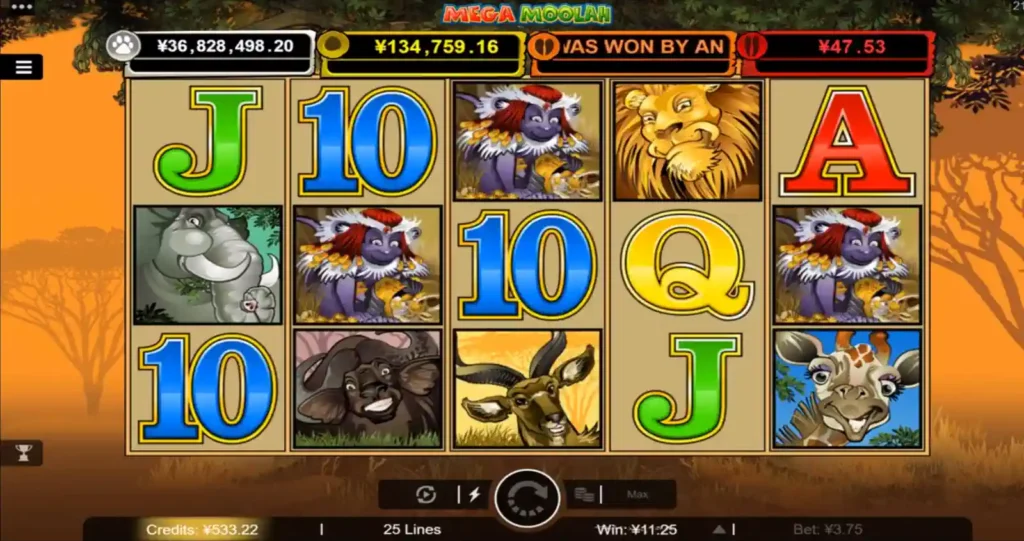
Microgaming’s Mega Moolah launched in 2006 and remains the most-played progressive in the regulated UK market in 2026. The title runs a 5-reel, 25-payline format with four progressive jackpots — Mini, Minor, Major, and Mega — funded by a percentage of every stake across the entire Microgaming network. Base-game RTP sits at approximately 88.12% before jackpot contribution, with the published Mega jackpot starting at £1 million and seeded again from £1 million after each hit. Stake range is 25p to £6.25 per spin. The Jackpot Wheel triggers randomly on any base-game spin and awards one of the four pool figures via a wheel-spin minigame. Volatility on the standard pay table is medium to high, and most sessions on Mega Moolah deliver returns close to the base 88% figure rather than touching the jackpots — which is the entire point of the maths. The title’s payout history includes the £15.18 million Guinness World Record win in 2018, which remains the largest online slot jackpot ever paid.
Hall of Gods
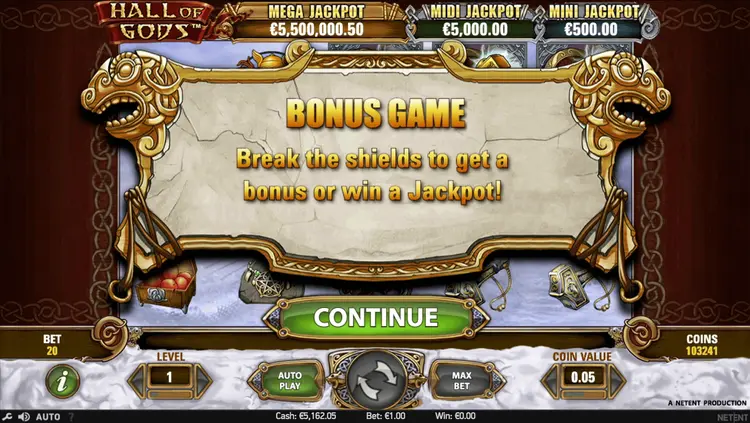
NetEnt released Hall of Gods in 2010 with a 5-reel, 20-payline Norse mythology format and a three-tier progressive jackpot structure. Base-game RTP sits at 95.50% before jackpot contribution, which is unusually high for the category and reflects NetEnt’s historic preference for thinner pool contributions. Stake range is 20p to £50 per spin. The Bonus Game triggers on three or more bonus shield symbols and presents a 15-shield grid where matching three of the same symbol awards either a free-spin round, a coin prize, or one of the three jackpots — Mini, Midi, or Mega. The Mega jackpot typically seeds at £100,000 and has historically reached £7 million before triggering. Sessions on Hall of Gods feel closer to a standard medium-variance slot than to the more punishing Mega Moolah base game, which is the trade-off for the smaller jackpot ceiling.
Wolf Gold
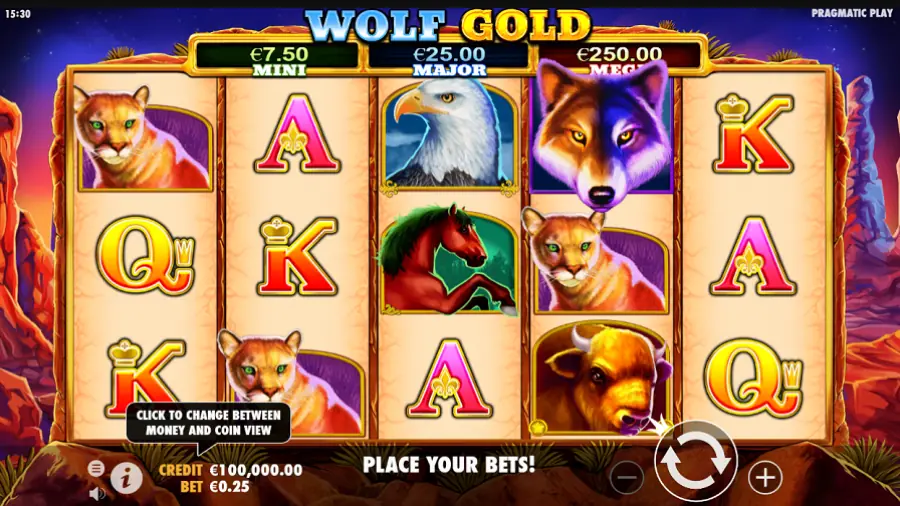
Pragmatic Play’s Wolf Gold released in 2017 with an RTP of 96.01% — high for any progressive title — a 5-reel, 25-payline configuration, medium volatility on the studio’s 4-out-of-5 scale, and three in-house progressive jackpots: Mini, Major, and Mega. The Money Respin feature triggers when six or more money symbols land, granting three respins where new money symbols reset the counter and a full screen of money symbols awards the Mega jackpot directly. Stake range is 25p to £125 per spin. The Mega jackpot pool typically sits around £30,000 to £100,000 across UK operators, the Major around £2,000 to £5,000, and the Mini around £200 to £500. The title bridges the gap between standard high-RTP slots and traditional progressive slots — players get a competitive base-game return alongside the jackpot ceiling, which is why it has remained one of the most-played releases at UKGC operators across multiple release cycles.
Divine Fortune
NetEnt’s Divine Fortune launched in 2017 with a base-game RTP of 96.59%, a 5-reel, 20-payline Greek mythology format, medium-high volatility on the studio’s official rating, and a three-tier progressive jackpot structure. Stake range is 20p to £100 per spin. The Jackpot Bonus triggers when three jackpot bonus symbols are collected on the reels, granting a 12-cell grid where matching three of the same colour awards Minor, Major, or Mega progressive jackpots. The Mega jackpot pool typically sits between £100,000 and £500,000 across UK operators, with documented hits in the £200,000 to £350,000 range. Divine Fortune is the modern NetEnt benchmark for progressive structure: high base-game RTP, regular feature engagement through Falling Wilds and Free Spins, and the jackpot pool as a rare upside rather than the entire point of the title.
Mega Fortune Dreams
NetEnt’s Mega Fortune Dreams released in 2014 as the spiritual successor to the original Mega Fortune that paid the £13.2 million record jackpot in 2013. Base-game RTP sits at 96.40%, the layout is 5 reels and 20 paylines, volatility is medium on the studio’s official rating, and the three-tier network progressive structure includes Rapid, Major, and Mega jackpots. Stake range is 25p to £50 per spin. The Bonus Wheel feature triggers on three Bonus Wheel symbols and grants spins on a multi-tier wheel where the centre awards the Mega jackpot directly. The Mega pool typically seeds at €100,000 and has reached €7 million before triggering, with documented hits across multiple jurisdictions. Sessions on Mega Fortune Dreams in 2026 deliver one of the more comfortable progressive experiences — the base RTP runs close to the standard market default, and the wheel feature triggers regularly enough that engagement doesn’t depend entirely on the rare jackpot draw. We cover the full landscape of jackpot slots including non-progressive jackpot structures separately.
How Progressive Slots Work
The maths behind progressive slots is built around a contribution split. Every stake on a progressive title is divided three ways: most goes to the standard pay-table return (the base RTP), a small percentage feeds the jackpot pool, and the remaining slice goes to the operator’s house edge. Contribution rates vary by title but typically sit at 1% to 5% of each stake — Mega Moolah contributes around 4.7% of stake to the four-tier pool, while NetEnt’s progressives typically contribute 1% to 2%. The base-game RTP is published separately from the total RTP, with the jackpot pool contribution counted as theoretical return only when accumulated across the platform’s full player base, not as expected return for any individual player.
Pool accrual is automatic and continuous. Every qualifying spin across the network adds to the pool until a player triggers the jackpot, at which point the pool resets to its seed value (typically £100,000 to £1 million depending on the tier and title) and begins accruing again. Network progressives accumulate fastest because the contribution base is largest — Mega Moolah pulls from every Microgaming-licensed operator running the title across multiple jurisdictions, which is why the pool reaches eight-figure peaks. Standalone progressives at single operators accrue slowly and rarely reach six figures, with most landing in the £10,000 to £50,000 range before triggering.
SpinHunter’s review and refresh cycle for progressive slots in 2026 evaluates titles quarterly. Re-evaluation triggers include any change to the base-game RTP at recertification, a documented shift in the jackpot contribution rate, removal of the title from major UKGC operator lobbies, or a paid-out hit that resets the seed and warrants tracking the rebuild trajectory. Titles that lose UK operator support are removed regardless of jackpot history, since UK players cannot legally play them. The list itself updates whenever a network-tier jackpot pays out, with the new seed value published alongside the title’s standard specs.
Key Characteristics of Progressive Slots
UK players spinning progressive slots in 2026 should expect a few consistent traits. Base-game RTP runs from 88% on the lowest-RTP entries (Mega Moolah at 88.12%) up to 96.59% on the highest-RTP modern releases (Divine Fortune), with the difference reflecting how aggressively the title diverts stake into the jackpot pool. House edge on the base game alone runs from 4% to 12%, which is structurally higher than the 3% to 4% baseline of standard market slots — and that’s before counting the jackpot pool contribution as expected return for the individual player.
Volatility on the base game varies widely, but progressive slots tend toward medium to high variance because the dramatic upper tail of the return distribution sits in the jackpot trigger rather than in regular bonus rounds. Mega Moolah runs medium-high variance on standard pay-table behaviour despite its 88% RTP, and Divine Fortune sits at medium-high on the NetEnt scale. Stake ranges in 2026 typically run from 20p to £100 per spin, though some titles cap lower by design — Hall of Gods at £50, Mega Fortune Dreams at £50, and similar deliberate constraints to prevent concentrated high-stake play from skewing pool accrual.
Device compatibility is universal. Every progressive slot from a serious provider runs in HTML5, loads in any modern browser without a plugin, and supports both landscape and portrait orientations on phones with touch controls mirroring the desktop button layout. Older network progressives like Mega Moolah have been re-engineered for HTML5 multiple times, and the current builds run identically on mobile and desktop. Session length implications track variance rather than progressive structure: a £100 bankroll spun at £1 per round on Mega Moolah typically lasts 60 to 90 minutes given the lower base RTP, compared to 95 to 130 minutes on a 96%-RTP medium-variance non-progressive equivalent — meaning progressive players pay for jackpot exposure in measurable session duration.
Common Misconceptions About Progressive Slots
The first misconception about progressive slots is that the jackpot is “due” once the pool grows above its historical average. It isn’t. Every spin is independent, the RNG has no memory, and the trigger probability on a £15 million Mega Moolah pool is identical to the trigger probability on a £1 million seed pool the day after a hit. The visible pool size doesn’t change the maths — it changes only the prize value if the trigger lands. Players who time their sessions around perceived “due” jackpots are paying for spins at the same odds whether the pool sits at £1 million or £10 million, with only the upside changing.
The second is that progressive slots have low base-game RTP because operators want to keep more money. The truth is more specific: the operator’s house edge on a progressive title is typically lower than the visible RTP gap suggests, because most of the difference between the 88% to 94% base RTP and the standard 96% baseline funds the jackpot pool rather than the operator. The jackpot pool eventually returns to a player as a single large win, but to the network’s player base as a whole rather than to any individual session. The maths is structurally honest about where the diverted stake goes, even if it’s never going to land for the typical session player.
The third is that you have to bet maximum stake to qualify for the jackpot on every progressive slot. This used to be widely true on older Microgaming and IGT titles where the Mega tier was max-bet only, but most modern progressive slots — including Mega Moolah’s current build, Divine Fortune, and Wolf Gold — qualify all spins regardless of stake size. The jackpot trigger probability scales with stake on most current titles, meaning a 20p spin has a smaller chance than a £5 spin but isn’t categorically locked out. UK players should always check the title’s help panel for stake-qualification rules before assuming the smaller stake is locked out of the top tier. We cover the broader landscape of fixed-jackpot structures in our low house edge slots guide for direct comparison.
How to Choose the Right Progressive Slots for You
The low-budget casual UK player — bankrolls under £50 a week, sessions of 15 to 30 minutes — should approach progressive slots with clear-eyed framing about the lottery-style proposition. The base-game RTP gap means you’ll lose money faster on Mega Moolah than on a 96%-RTP non-progressive equivalent, in exchange for the small chance of a network jackpot trigger. If that trade-off appeals, stake at 25p to 50p per spin on a £20 weekly slot budget, choose titles with higher base RTP within the category — Wolf Gold at 96.01%, Divine Fortune at 96.59%, Mega Fortune Dreams at 96.40% — and treat the jackpot pool as essentially impossible rather than as a realistic upside. The honest framing is paying for entertainment with a tiny chance of a transformative win.
The mid-stakes regular — sessions of 45 to 90 minutes, weekly bankrolls in the £100 to £400 range, comfortable with £1 to £5 stakes — gets a reasonable match from progressive slots when the title is selected for high base RTP rather than headline jackpot size. Wolf Gold and Divine Fortune deliver competitive base-game returns alongside meaningful jackpot pools, and a £200 bankroll spun at £1 to £2 per round delivers 100 to 200 spins per session — enough volume for one or two feature triggers and a slim but non-zero chance of the jackpot bonus engaging. Mid-stakes regulars should confirm the operator’s deployed RTP and the published contribution rate before each session.
The high-roller bankroll player — sessions over two hours, weekly bankrolls of £1,000 plus, stakes from £5 to £100 per spin — typically uses progressive slots for the jackpot exposure specifically rather than for return optimisation. At higher stakes the jackpot trigger probability climbs proportionally on most modern titles, which is the only profile where chasing the network pools makes sustained mathematical sense. Strategy at this stake level is fixed-stake discipline with a hard loss cap, typically 30% of session bankroll, and a willingness to walk away long before the pool engages. We cover the broader bankroll considerations further in our real money slots guide.
Tips and Strategy for Playing Progressive Slots
The first useful principle is honest expectation-setting. The probability of triggering a network-tier progressive jackpot on any individual spin is typically between 1 in 10 million and 1 in 50 million depending on the title and stake. A player spinning £1 stakes at 600 spins per hour for two hours per day every day of the year accumulates roughly 438,000 spins annually — meaning even at the most generous trigger probability, the expected wait between Mega-tier hits for that player is over 22 years of daily play. Treat the headline jackpot as a remote upside, not as a reasonable session outcome.
The second is base-RTP-led title selection within the category. Within progressive slots, base-game RTP varies from 88% to 96.59%, which is a substantial spread. UK players who plan to spin progressive titles regularly are systematically better served by Divine Fortune, Wolf Gold, and Mega Fortune Dreams over Mega Moolah from a pure return-optimisation standpoint, even though the latter offers a larger headline jackpot pool. The choice between the two is genuinely a value judgement: are you willing to accept lower hourly expected return for a much larger upside ceiling? Both answers are reasonable, but the maths trade-off should be explicit rather than assumed.
The third is session limit discipline, which matters more in this category than in any other because the lower base RTP accelerates bankroll erosion in the absence of jackpot triggers. Set a real-money bankroll before the session, set a hard loss cap at 30% of that bankroll rather than the more permissive 50% used elsewhere, and walk away when the cap fires. UKGC operators in 2026 are required to display loss alerts during play and to provide deposit limits, time-outs, and reality checks in account settings. The maths does not reward chasing the pool — every spin is independent regardless of cumulative session loss.
Leading Providers for Progressive Slots in 2026
Microgaming continues to define the progressive slots category in 2026 through the Mega Moolah network, including Atlantean Treasures, Absolootly Mad, and Sisters of Oz progressive variants — all of which feed the same Mega-tier pool that has paid the largest jackpots in regulated online gambling history. NetEnt holds a strong second position with Hall of Gods, Divine Fortune, Mega Fortune Dreams, and Mercy of the Gods, all certified at higher base-game RTP than the Microgaming standard and built around three-tier progressive structures with stake-qualified triggers. Pragmatic Play has expanded its progressive footprint through Wolf Gold, Mustang Gold, and the broader Money Collect family, where in-house progressives sit alongside the studio’s standard high-RTP base-game design.
Yggdrasil contributes Empire Fortune and Joker Millions to the category, with the latter known for its clean three-tier structure and verified UK deployment. Playtech’s Age of the Gods network runs across multiple in-house progressives at UKGC operators licensing the Playtech platform, with the Age of the Gods family delivering both jackpot exposure and standard high-RTP base-game returns through 2025 and into 2026. IGT maintains its position through MegaJackpots titles like Cleopatra MegaJackpots and Wheel of Fortune Megaways, both of which feed multi-tier networks with verified UK availability. The category remains dominated by older studios with established jackpot networks rather than newer modernised entrants, since pool size depends on installation base across operator partners.
Progressive Slots vs Related Slot Types
The category sits in a specific place compared to fixed-jackpot slots and standard pay-table slots, and direct comparison makes the trade-offs explicit. The axes that matter for that comparison are the typical RTP band, the jackpot ceiling, the trigger probability, and the player profile that suits each tier. The table below summarises those four axes side by side.
| Slot Tier | Typical Base RTP | Jackpot Ceiling | Trigger Probability | Player Profile |
|---|---|---|---|---|
| Standard slots | 95.5%–96.5% | 1,000x–10,000x stake | Capped, predictable | Mass market, default deployment |
| Fixed-jackpot slots | 95.5%–96.5% | 5,000x–150,000x stake | Documented, RNG-bounded | Variance-tolerant ceiling chasers |
| Progressive slots | 88%–96.5% | £100,000–£15M+ pool | 1 in 10M to 1 in 50M | Lottery-style upside seekers |
| Network progressives | 88%–94% | Multi-million pools | Rarest in category | Pool-watching jackpot specialists |
The table makes the trade explicit: progressive slots offer a fundamentally different value proposition from fixed-jackpot slots. Fixed jackpots cap at multiples of stake (typically 5,000x to 150,000x), and the trigger probability is documented within the certified game file — meaning a 50,000x cap on a 1-in-500,000 trigger probability has predictable expected return. Progressive jackpots cap at the pool size, which scales with network engagement, and the trigger probability is rarer than any fixed structure. UK players evaluating where they fit should also consider the highest RTP slots tier for sessions where return optimisation matters more than jackpot exposure.
Where to Play Progressive Slots at UK Casinos
Before you deposit, verify the operator. Every UK-facing casino must hold a current UK Gambling Commission licence — that’s verifiable on the UKGC public register, where the licence number printed in the casino’s footer must match an active record. The casino’s help panel should also publish the base-game RTP for every progressive slot it deploys, alongside the jackpot contribution structure and any stake-qualification rules. Some operators integrate progressive titles at lower base-RTP variants under separate certification, and the help panel is the only authoritative source for the deployed build.
The April 2026 UKGC rule set then applies once you cross from demo into real money. Bonus wagering caps at 10x the bonus value, the maximum bet during any bonus play is £5 per spin or hand regardless of the cash stake limit on the title, mandatory loss alerts must display when net loss thresholds are reached during a session, and the 2021 bonus-buy ban remains in force on every UKGC-licensed slot. Most progressive titles exclude themselves from bonus wagering entirely because the jackpot trigger from bonus-funded spins creates regulatory complications around prize ownership — UK players should confirm the title’s bonus eligibility before assuming wagering progress applies.
Responsible Gambling
UKGC operators in 2026 are required to provide a full set of in-account responsibility tools to every UK player. Deposit limits can be set daily, weekly, or monthly and apply across the operator’s network within their licence. Reality checks display elapsed session time and net profit or loss at intervals you control. Time-outs lock the account from 24 hours up to 6 weeks. Self-exclusion at the operator level prevents account access for a fixed term you choose. These tools are configurable before you make your first cash deposit and remain accessible throughout your relationship with the operator.
External support exists when operator-level tools aren’t enough. GamStop is the UK’s national self-exclusion scheme, blocking access to every UKGC-licensed gambling site for a chosen period of six months, one year, or five years across the entire network. GamCare provides counselling and a live helpline on 0808 8020 133 with seven-day support, reaching trained advisers for confidential discussions. BeGambleAware operates the awareness side, providing information, treatment referrals, and self-assessment tools for anyone wanting to evaluate their own gambling behaviour without yet committing to support. 18+ Please gamble responsibly.
Frequently Asked Questions
* 18+ only. New customers only. T&Cs apply. Gamble responsibly.