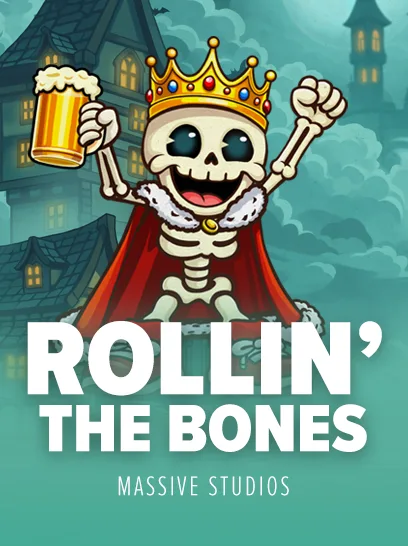
Rollin' The Bones Slot Demo And Review
Rollin' the Bones brings comic horror to a town of skeletons, bats and Irish-festival music, using a 6×5 scatter-pays grid where wins cascade into pentagrams.
18+ | Gamble Responsibly | T&Cs Apply
Try Rollin' The Bones For Free
18+ | Free demo mode — no registration or deposit required. Real money play is available at UKGC-licensed casinos only.
18+ | Free demo mode — no registration or deposit required. Real money play is available at UKGC-licensed casinos only.
No Deposit



Velobet
50 Free Spins + £10 Bonus
Accepted payments

Zizobet
50 Free Spins No Deposit
Accepted payments
Cosmobet
50 Free Spins No Deposit
Accepted payments

Rolletto
50 Free Spins No Deposit
Accepted payments





* 18+ only. New customers only. T&Cs apply. Gamble responsibly. BeGambleAware.org
This site earns commission when readers click casino links. This does not affect our editorial independence or the accuracy of this review.
Key Takeaways
| Game Data | Verified Detail |
|---|---|
| Provider and Release | Massive Studios, released 30 July 2026 according to the operator’s Game Information table. |
| RTP | 96.53%, supported by the operator’s body copy and Game Information table. |
| House Edge | 3.47%, the lowest edge among the titles in this recent editorial run. |
| Grid and Pays | 6 reels by 5 rows with Scatter Pays, cascades and no fixed paylines. Wins require at least 8 matching symbols anywhere. |
| Max Win | The Rollin’ the Bones max payout is 10,000x in base play; 20,000x only when a bonus buy is activated. GB comparison only: the base ceiling equates to £50,000 at £5 for ages 25+ or £20,000 at £2 for ages 18–24; the purchase-only ceiling equates to £100,000 or £40,000. |
| Bet Range | Operator range €0.10–€1,000.00 per spin. The statutory GB comparison points are £5 for ages 25+ and £2 for ages 18–24. |
| Volatility | High, with a Volatility Switch applied whenever the purchase menu is used. |
| Race Track | Opens when at least 1 dice symbol lands alongside a winning combination. Bones advances by the rolled total and encounters multipliers, boosts, extra dice or a track reset. |
| Free Games | At least 4 scatter symbols award up to 16 free spins with dice symbols and multipliers. |
| Purchase Menu | Enhancer 1 at 2.50x per spin, Enhancer 2 at 5.00x per spin, Bonus Buy 1 at 100x and Bonus Buy 2 at 300x. |
Rollin’ the Bones Quick Verdict
This Rollin’ the Bones review begins with the essentials: the 30 July 2026 Massive Studios release combines 96.53% RTP, high volatility and 6×5 Scatter Pays with a dice-driven board above the reels. The Double Flux studio comparison provides the nearest same-studio ceiling reference. Its maximum is 10,000x in base play and 20,000x only through a bonus buy; the operator’s Game Information table obscures that distinction by displaying the higher figure alone.
The game is not available through UKGC-licensed operators. Its sharper editorial distinction is the distance between ordinary symbol values and the ceiling: a 50.00x Horseshoe result means the base maximum is 200 times that symbol win, while the purchase-only maximum is 400 times it.
RTP, volatility and bonus mechanics can change, so current figures should be read in the game information before any deposit. For another dark cascade model, the Tome of Madness grid supplies a separate comparison. The conditional recommendation is straightforward: Rollin’ the Bones suits players seeking high-volatility cascades with an active board feature, while those wanting fixed paylines, disclosed trigger probabilities or a ceiling independent of purchases should skip it.
Math Model
The operator’s body copy and Game Information table both state 96.53% RTP and a 3.47% house edge. The same material classifies volatility as High, while the purchase interface applies a Volatility Switch without defining a separate return percentage for each menu option.
Rollin’ the Bones RTP Detail
At 96.53%, the theoretical return is €96.53 for every €100 staked across a sufficiently large sample, leaving €3.47 as expected house advantage. This is a long-run mathematical ratio rather than a session forecast, and high volatility can produce results far removed from it over ordinary play.
No configurable RTP ladder or purchase-specific RTP appears in the operator documentation. The 3.47% edge is the lowest recorded in this recent editorial run, although that does not soften the game’s High classification or disclose how return is divided between normal cascades, Race Track events and Free Games.
The edge and volatility answer different questions. The 3.47% edge describes average long-run cost as staking accumulates, while High volatility describes an uneven route through that average. The £100 bankroll illustrations of about 576 spins at £5 and 1,441 at £2 therefore express expected-loss arithmetic, not a likely stopping point. A balance can disappear earlier during a poor sequence or last longer when wins interrupt the outlay. Being the lowest edge in this review run improves the theoretical cost comparison, but it does not turn the calculation into a session timetable.
Volatility in Practice
The Rollin’ the Bones volatility setting is High, indicating that more of the theoretical return is concentrated in less common, larger outcomes. The cascade system can extend one paid spin through several symbol removals, while Race Track multipliers can enlarge a winning sequence, but neither mechanic supplies a numeric frequency from which short-session pacing can be modelled.
The Volatility Switch applies whenever the studio-logo purchase menu is used. Its exact mathematical adjustment is absent from the public rules, so it should be treated as a warning that the distribution changes rather than as evidence that any one purchase tier offers stronger expected value.
Rollin’ the Bones Max Win
The Rollin’ the Bones max win is 10,000x during base play and 20,000x only after activating a bonus buy option. The operator does not identify which one of the 4 menu entries unlocks the doubled ceiling, so none should be singled out as the qualifying purchase.
On the statutory GB comparison scale, 10,000x equals £50,000 at the £5 cap for players aged 25+ or £20,000 at the £2 cap for ages 18–24. The purchase-only 20,000x equals £100,000 and £40,000 at those respective stakes. These calculations provide scale rather than attainable GB outcomes for this title; the operator-side game file itself permits €0.10–€1,000.00 stakes.
The paytable gives the maximum unusual context. A Horseshoe pays 50.00x for at least 15 symbols, putting the base ceiling 200 times above the highest listed symbol return and the purchase-only ceiling 400 times above it. By comparison, the Ninja Rabbit 2 slot places its base ceiling 2,500 times above its leading symbol result, concentrating far more distance in extreme multiplier events.
The 200-fold ratio is more revealing than the ceiling in isolation. A leading Horseshoe group already represents a substantial paytable result relative to the 10,000x base maximum. A strong cascade can accumulate value from several independently qualified groups, and Race Track multipliers can enlarge the associated winning sequence, so those mechanics cover far more of the distance than they would if the leading symbol sat thousands of times below the ceiling. The model does not need an extreme multiplier event to bridge almost the entire gap in the way a much wider paytable distance would. The purchase-only 400-fold ratio doubles that distance, but it retains the same underlying relationship between a comparatively substantial symbol result and the maximum. This says nothing about how often either ceiling occurs, because no maximum-win probability is published.
Hit Frequency vs Bonus Trigger
Hit frequency measures how often any paid result occurs, whereas bonus-trigger frequency measures how often the required feature symbols appear together. Neither rate is disclosed for Rollin’ the Bones, and no probability is supplied for a 100x result, a 1,000x result or either maximum.
The rules reveal conditions, not frequencies. At least 8 matching symbols form a Scatter Pays win, at least 4 dedicated scatters trigger up to 16 free spins, and a Race Track event requires dice alongside a winning combination. None of those thresholds supports a numeric estimate of how often the event occurs.
Bonus Features
The Rollin’ the Bones bonus features are explained thoroughly, but the feature sheet omits trigger probabilities and separate mode returns. That makes the mechanics clear while leaving the likely gaps between feature events unpredictable.
Rollin’ the Bones Scatter Pays Cascades
At least 8 matching symbols landing anywhere on the 6×5 grid produce a Scatter Pays win; adjacency and paylines are irrelevant. Winning symbols become pentagrams and disappear before replacement symbols fall into their positions, allowing further wins within the same paid spin.
Each new group must independently meet the 8-symbol threshold. This is a scatter-pays cascade model, not cluster pays, because matching symbols do not need to touch one another.
Race Track
The Race Track can open during any base or bonus spin, but only when at least 1 dice symbol appears alongside a winning combination. All visible dice roll, their values are added together and Bones moves that total around the track above the reels.
Both parts of that condition matter. A dice symbol without a qualifying win does not open the Race Track, and a winning combination without a dice symbol does not open it either. The board feature therefore rides on base-game success instead of replacing an unsuccessful reel result with a separate chance. The reels first need to produce a valid Scatter Pays group on the same spin that supplies the dice, linking the side board directly to the game’s ordinary win evaluation.
Landing spaces can apply multipliers, add further dice rolls, activate movement boosts or reset the track after Bones passes GO. The operator does not describe progress as persistent between separate spins or sessions, so the documented mechanic is the current Race Track event rather than a permanent progression system.
The rolled total governs Bones’s movement, while the destination determines what follows. Multipliers enlarge the winning sequence, boosts alter his position, and extra dice add further rolls to the active event. Passing GO instead produces the documented reset. These effects perform different jobs within one chain: movement decides where Bones goes, while the reached space can change the value or extend the sequence. The possibility of further dice means the Race Track need not end with its opening roll, although no published rate indicates how often that extension occurs.
Boost and Super Boost
A standard Boost advances Bones by 2–4 spaces. A Super Boost moves him by 8–31 spaces, potentially crossing more track positions and passing GO within the same event.
The two ranges operate on clearly different movement scales. A Boost makes a contained adjustment of 2–4 spaces, whereas a Super Boost covers 8–31 and can therefore shift the destination much farther around the board. That greater movement also makes passing GO more relevant to the Super Boost range, but the distance itself is not a payout.
These values describe movement distance, not a direct cash multiplier or event frequency. The eventual value still depends on the spaces reached and the winning combination that allowed the Race Track to open.
Rollin’ the Bones Free Games
At least 4 scatter symbols trigger up to 16 free spins, with dice symbols and multipliers remaining active. The free-spin round therefore preserves the Race Track relationship rather than switching to an unrelated bonus format.
The phrase “up to 16” is an upper limit, not a fixed award of 16 spins. The public feature description provides no separate retrigger schedule or numeric probability for reaching the full allowance.
Feature Buy Options (Stake-only)
The purchase layer is compact, but the operator does not disclose what each tier specifically awards or how its return profile changes. The menu is opened through the developer logo inside the client, and using any entry applies the documented Volatility Switch.
Rollin’ the Bones Enhancers
Enhancer 1 costs 2.50x the stake per spin, while Enhancer 2 costs 5.00x per spin. They are recurring per-spin modifiers rather than one-off 100x or 300x purchases, but the operator does not assign a particular feature, multiplier range or return percentage to either enhancer.
That recurring structure makes an Enhancer an open-ended commitment rather than a purchase with a fixed session total. Each spin taken while Enhancer 1 or Enhancer 2 is active carries its respective 2.50x or 5.00x charge, so the overall cost depends on how long the player remains in the mode. The price of the next spin is stated, but the eventual total is determined by the number of spins selected. That is a different cost decision from paying once to activate a Bonus Buy.
Bonus Buy Tiers
Bonus Buy 1 costs 100x the selected bet and Bonus Buy 2 costs 300x. The operator states only that activating one of the bonus buy options raises the maximum from 10,000x in base play to 20,000x; it does not identify the qualifying tier or specify what each buy delivers.
The operator’s English-language page prices the second bonus buy at 300x, while a localised version of the same page lists 500x. The price shown in the client at the moment of purchase is the one that applies.
The Bonus Buy entries set known one-off costs at the point of activation, unlike the Enhancers’ accumulating per-spin charges. That distinction makes the immediate commitment visible without explaining the contents or mathematical value of either tier. The difference between 100x and 300x cannot be used to infer which option raises the ceiling, because the operator does not connect the purchase-only 20,000x maximum to a named menu entry.
Volatility Switch and GB Status
The Volatility Switch confirms that using the menu changes the distribution profile, but no per-option mathematical breakdown supports ranking the 4 entries. Feature buy-in facilities cannot be offered to customers in Great Britain under Gambling Commission RTS 14, so these purchases could not appear in a GB-licensed version.
Base Game
The base game uses 6 reels, 5 rows and no fixed paylines. At least 8 matching symbols anywhere on the grid pay before changing into pentagrams and disappearing, and the next symbol drop can begin another cascade. The operator’s Game Information table records a stake range of €0.10–€1,000.00 per spin.
Visually, the game presents comic horror through a spooky town, skeleton characters, bats, bones and colourful gem symbols. The gothic Immortal Romance setting provides a darker horror comparison. The operator describes it as “more adorable than terrifying”, while an Irish-festival soundtrack gives the presentation a lighter tone than the imagery suggests.
The public game information does not define a conventional Wild symbol or separate Wild substitution rules. The Rollin’ the Bones free spins feature awards up to 16 spins from at least 4 dedicated scatters, while dice symbols are conditional Race Track activators and must appear alongside an existing winning combination.
Rollin’ the Bones mobile compatibility is not specified by device, operating system or HTML5 label in the public Game Information table. The 6×5 client and Race Track layout are documented, but iOS and Android support should not be inferred from the grid format alone.
Published Symbol Values
The operator publishes the complete paytable at a bet of €1.00, allowing each printed return to be read directly as a multiple of stake. The 9 regular symbols form 6 distinct pay levels because the 3 lower gems share one schedule and the Orange and Red Gems share another.
Nine symbol identities therefore do not create nine separate value curves. The Green, Purple and Yellow Gems are interchangeable in payout terms, as are the Orange and Red Gems, leaving the Candle, Skeletal Hand, Mug of Beer and Horseshoe to establish the remaining individual levels. The result is a compressed lower half of the paytable followed by clearer separation among the higher symbols. At the top match band, one Horseshoe result is worth more than two Mug of Beer results, giving the leading symbol a pronounced advantage even before any Race Track multiplier is involved.
| Symbol | 8–9 | 10–11 | 12–14 | 15+ |
|---|---|---|---|---|
| Green, Purple or Yellow Gem | 0.10x | 0.30x | 1.00x | 3.00x |
| Orange or Red Gem | 0.30x | 0.50x | 2.00x | 5.00x |
| Candle | 0.50x | 1.00x | 5.00x | 8.00x |
| Skeletal Hand | 1.00x | 2.00x | 8.00x | 15.00x |
| Mug of Beer | 2.50x | 5.00x | 10.00x | 20.00x |
| Horseshoe | 4.00x | 10.00x | 20.00x | 50.00x |
The four match bands determine how each independently qualifying symbol group contributes to a cascade. Reaching 8–9 symbols opens the lowest band, 10–11 advances that same symbol to the next level, 12–14 raises it again, and 15 or more reaches its top listed return. Counts from different symbols cannot be pooled to clear the 8-symbol entry point. After winning symbols disappear, every new group formed by the replacement drop is assessed afresh and must reach at least 8 on its own. A cascade therefore accumulates value through a succession of separately qualified groups rather than carrying an earlier group’s count into the next drop. Larger groups raise the value within one evaluation, while further cascades add new evaluations to the same paid spin.
The Horseshoe pays 50.00x for at least 15 symbols, compared with 20.00x for the Mug of Beer. That relatively substantial regular-symbol return is why the 10,000x base maximum is only 200 times the leading paytable outcome, rather than thousands of times above it.
Pros & Cons
| Pros | Cons |
|---|---|
| The operator clearly separates the 10,000x base ceiling from the 20,000x purchase-only ceiling, equal on a GB comparison scale to £50,000 or £20,000 in base play and £100,000 or £40,000 after a qualifying buy. | The Game Information table flattens the maximum to 20,000x even though that figure requires a bonus buy. |
| The 96.53% RTP creates a 3.47% house edge, the lowest in this recent editorial run. | High volatility still concentrates much of that return in less common outcomes. |
| The 50.00x Horseshoe result leaves less distance between the regular paytable and the ceiling than most extreme-multiplier games. | The purchase-only 20,000x maximum is the smallest advertised ceiling in the developer’s range, with the Double Flux slot its closest studio peer. |
| The Race Track can activate in base play as well as Free Games, adding movement, multipliers and extra dice outside the bonus round. | It requires both dice and a winning combination, while the operator rules omit its trigger probability. |
| Scatter Pays and cascades provide a more flexible win pattern than the fixed-payline Cactus Cassidy slot. | The public rules do not define conventional Wild behaviour or explain each purchase tier’s individual award. |
Where to Play Rollin’ the Bones
For readers checking Rollin’ the Bones UK availability, no Rollin’ the Bones casino option exists through a UKGC-licensed operator: the title is Stake Engine-exclusive, and the Stake operator ceased trading in Great Britain on 11 March 2025 following the Gambling Commission notice dated 12 February 2025. UK-available alternatives include the Death Dominion slot and Soaked by Seamen slot, although the latter’s own purchase layer is also unavailable in Great Britain. Self-exclusion through GamStop applies across UKGC-licensed operators rather than to an individual slot. A Rollin’ the Bones demo found on a third-party site cannot establish which configuration is live or evidence a real-money return.
Similar Slots
The closest comparisons come from the same distribution catalogue or share the conditional-ceiling structure. First-party numerical specifications are not reproduced for peers whose live game information was outside the documented evidence.
| Slot | Developer | Key Difference |
|---|---|---|
| Double Flux | Massive Studios | Dual-reel flux mechanic rather than a board-game track; Stake-exclusive. |
| Rooster Returns | Massive Studios | Established catalogue reference with a different feature identity; Stake-exclusive. |
| Chameleon Bonaparte | Massive Studios | All-ways structure instead of Scatter Pays and cascades; Stake-exclusive. |
| Cactus Cassidy | Massive Studios | Fixed paylines instead of anywhere-pay groups; Stake-exclusive. |
| Ninja Rabbit 2 | Titan Gaming | Its base ceiling is 2,500 times its leading symbol result rather than 200 times; Stake-exclusive. |
The Double Flux slot is the closest studio comparison on advertised ceiling, but its dual-reel flux design does not recreate dice-led movement. The Rooster Returns slot works better as a broader catalogue benchmark than as a direct mechanical substitute.
The Chameleon Bonaparte slot suits comparison with alternative win evaluation because all-ways play differs fundamentally from 8-symbol Scatter Pays. The Cactus Cassidy slot sits farther away structurally through its fixed-payline format.
The Ninja Rabbit 2 slot provides the sharpest mathematical contrast. Both games separate base and purchase-enabled ceilings, yet the 2,500-to-1 distance between its leading symbol result and base ceiling is far wider than Rollin’ the Bones at 200-to-1.
Player Sentiment & Reviews
The Rollin’ the Bones game is mechanically distinctive, mathematically well documented and heavily constrained by its distribution. The strongest case rests on the Race Track and close paytable-to-ceiling relationship, not on broad community evidence.
| Theme | Observation |
|---|---|
| Mechanic reception | The Race Track gives ordinary winning spins access to dice movement, multipliers and boosts rather than reserving the side game for Free Games. Its dual requirement of dice plus a win is clearly documented, but no event rate supports a claim about pacing. |
| Visual and atmospheric response | The operator frames the skeleton town as comic rather than severe horror, supported by colourful gems and Irish-festival music. That creates a lighter presentation than the title and skeletal artwork initially imply. |
| Streamer coverage | No dependable clip pattern appears in the documented industry material. Claims about recurring large-win sequences, average bonus gaps or on-stream maximum attempts are therefore excluded. |
| Community pattern | A sustained forum consensus is absent from the attributable evidence used here. The verdict consequently relies on the operator paytable and feature rules rather than repeating unattributed praise or complaints. |
| Comparator pairing | The Ninja Rabbit 2 slot is the most useful mathematical pairing because both titles double their base ceiling through a purchase condition. The Double Flux slot supplies the closest Massive Studios ceiling context without duplicating the Race Track. |
| Coverage gap | Hit frequency, Free Games trigger probability, Race Track frequency and maximum-win probabilities are omitted from public documentation. The operator also leaves each purchase tier’s specific award and the identity of the ceiling-raising option unexplained. |
The public-facing appeal is primarily mechanical. Scatter Pays, cascading removals and a side board that can activate during base play form a coherent system, while the complete symbol paytable makes the distribution shape more visible than promotional ceiling figures alone.
The same structure creates clear dividing lines. The highest 20,000x ceiling is reachable only after activating a bonus buy, while players staying in base play face the 10,000x limit. The Race Track is available beyond Free Games, but it still needs dice to land alongside a winning combination, so it enhances a successful reel event rather than providing an independent route from an unsuccessful spin. Players who value interconnected mechanics may see that dependency as coherent; those wanting the board to create its own opportunities may see it as another gate.
The absence of disclosed event probabilities sharpens that divide. The rules explain what has to happen but not how regularly dice and wins coincide, how often Free Games begin or how remote either ceiling is. That prevents the feature rhythm from being assessed in advance and leaves preference to rest on the documented structure. The resulting split is therefore understandable without treating it as evidence of either faulty operation or broad approval.
The recurring weakness is evidence breadth rather than an identified defect in reel operation. Without robust streamer or community patterns, no claim can be made that the Race Track appears regularly, that Free Games have predictable spacing or that one purchase tier receives stronger reception.
Where Rollin’ the Bones Sits in Massive Studios’ Lineup
Massive Studios is an exclusive Stake Engine supplier whose public studio site offers limited catalogue specification detail, making operator game information the stronger source for individual releases.
| Slot | Position vs Rollin’ the Bones |
|---|---|
| Rollin’ the Bones | The reference title: 96.53% RTP, High volatility, Scatter Pays with cascades and a dice-led Race Track, and a 10,000x base ceiling that reaches 20,000x only through a bonus buy. |
| Double Flux | The closest studio peer, built on a dual-reel flux system rather than track movement. |
| Rooster Returns | A broader catalogue benchmark with a different feature identity. |
| Chameleon Bonaparte | An all-ways evaluation of the grid instead of Scatter Pays. |
| Cactus Cassidy | Fixed paylines and a more conventional reel structure. |
An RTP percentile cannot be assigned responsibly because the studio’s public catalogue shell does not carry comparable return figures for these siblings. Rollin’ the Bones nevertheless has a strong individual headline at 96.53%, giving it a 3.47% edge that compares favourably within this editorial batch.
Ceiling position is clearer. The 20,000x maximum, available only after activating a bonus buy, is the smallest advertised maximum in the studio range; base play ends at 10,000x. Its defence is the unusually short 200-to-1 distance between the 50.00x Horseshoe result and the base ceiling.
Mechanically, the game occupies a distinct niche between the all-ways Chameleon Bonaparte slot and fixed-payline Cactus Cassidy slot. This is the developer’s niche scatter-pays and board-game release rather than its catalogue ceiling leader.
Is Rollin’ the Bones Worth Playing?
Rollin’ the Bones is worth considering only for players who prioritise its dice-led Race Track, 96.53% RTP and relatively close paytable-to-ceiling distribution over broad availability and fully disclosed feature probabilities. Rollin’ the Bones free play cannot evidence a real-money return or establish which purchase configuration is active.
High-roller bankroll grinders: The High classification and 3.47% edge matter more than stake potential. On a GB comparison scale, the 10,000x base ceiling equals £50,000 at the £5 cap for ages 25+ or £20,000 at the £2 cap for ages 18–24; the purchase-only 20,000x ceiling equals £100,000 or £40,000. Casual session players: The operator’s €0.10 floor permits small nominal stakes, and low-deposit casino options often permit £1–£2 entries for UK-playable alternatives. At the £5 and £2 GB comparison points, a £100 bankroll has long-run expected-loss spans of about 576 and 1,441 spins respectively, not predicted session lengths. Bonus hunters and feature buy players: The 4-option menu is clearly priced, but its individual awards and returns are absent from the rules, while feature buys are unavailable at UKGC-licensed casinos. Free spins no deposit offers provide a lower-commitment route to UK-playable bonus rounds, although they do not reproduce this purchase system. Whichever profile applies, limits matter more than slot selection, and BeGambleAware provides guidance on spending controls and recognising harm.
Confirmed strengths: the Stake game page supports the 96.53% RTP, 3.47% edge, complete symbol paytable and detailed Race Track sequence. The 50.00x Horseshoe result also places the 10,000x base ceiling only 200 times above the leading regular-symbol return, giving cascades and track multipliers a materially shorter distance to cover than many high-ceiling games.
Confirmed weaknesses: the higher 20,000x maximum is purchase-dependent, despite the Game Information table presenting it as a flat figure. High volatility remains a demanding distribution, while hit frequency, feature probabilities, retrigger details and the award attached to each menu tier are absent from the operator rules.
The Double Flux slot is the closest same-studio ceiling comparison, while the Death Dominion slot supplies a UK-available alternative for readers prioritising regulated-market access. Rollin’ the Bones has the more unusual board-game identity, but neither a purchase-dependent ceiling nor an undisclosed trigger pattern should be mistaken for added expected value.
Alternatives by Player Goal
If the closest studio ceiling matters: the useful comparison is another release from the same exclusive catalogue. The Double Flux slot is the nearest same-studio ceiling peer, replacing dice-led track movement with a dual-reel flux mechanic.
If conditional-ceiling distribution matters: the key question is how far the leading symbol sits below the maximum. The Ninja Rabbit 2 slot stretches its base ceiling to 2,500 times its leading symbol result, compared with 200 times here.
If all-ways evaluation matters: a player may prefer a layout that assesses wins differently from anywhere-pay symbol counts. The Chameleon Bonaparte slot provides that same-studio all-ways contrast.
If fixed paylines matter: a conventional line structure removes the need to follow 8-symbol Scatter Pays thresholds. The Cactus Cassidy slot is the same-studio fixed-payline alternative, although it shares the Stake-exclusive distribution model.
If UK-available play matters: the appropriate substitute must come from outside this exclusive catalogue. The Soaked by Seamen slot is available through UKGC operators, though its own purchase layer is unavailable in Great Britain.
How This Review Was Verified
This review uses product information current to 1 September 2026. Primary evidence comprises the Stake game page, its Game Information table, How to Play rules, full €1.00 paytable and 4-entry purchase menu; the developer’s public site supplies no deeper corporate or game specifications. The operator’s body copy and Game Information table both record the Rollin’ the Bones RTP at 96.53% with a 3.47% edge, while its summary header rounds that edge to 3.48%; the Game Information figure is the one used throughout, and the in-client information panel is the point-of-play reference. Distribution evidence comes from the Only on Stake and Stake Engine labels, supported by the Gambling Commission’s dated notice recording the Stake operator’s Great Britain exit. Published specification data was used generically for product identity rather than to override first-party figures. Public documentation gives no hit frequency, bonus-trigger probability, threshold-win probability, Race Track rate or per-purchase return. Players should treat any figure here as point-in-time and confirm the active configuration in the operator help panel before depositing real money. RTP, volatility, stake limits, and feature availability are subject to operator-side updates that this review cannot pre-empt.
Responsible Gambling
High volatility makes short-term results unpredictable even with a comparatively low 3.47% house edge. A fixed spending limit, time limit and deposit limit should be set before play, with no attempt to recover previous losses by raising stakes or extending a session.
RTP describes long-run expected loss rather than the length of one session. Using GB statutory stakes purely as comparison points, £100 ÷ (£5 × 0.0347) gives about 576 theoretical spins at the £5 cap for ages 25+, while £100 ÷ (£2 × 0.0347) gives about 1,441 at the £2 cap for ages 18–24. A separate cost-of-play illustration at roughly 500 spins per hour gives 500 × £5 × 0.0347 = £86.75 theoretical hourly loss and 500 × £2 × 0.0347 = £34.70. Actual sessions can differ sharply from both calculations.
Independent help remains available when personal limits stop working. If gambling stops being enjoyable or you find it difficult to stick to limits, support is available through GamCare on the National Gambling Helpline 0808 8020 133, free and confidential, 24 hours a day.
Verified against developer documentation, UKGC casino game libraries, and independent review sources available at time of review.
Other popular slots you might enjoy: