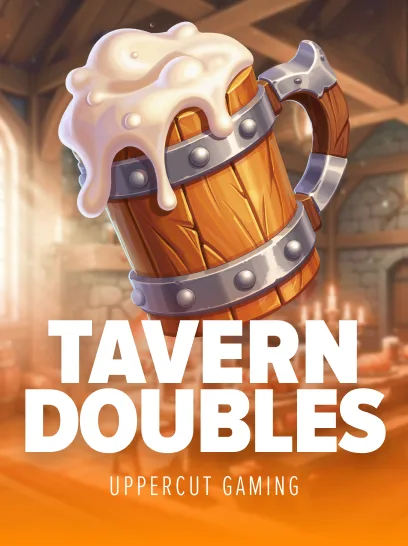
Tavern Doubles Slot Demo And Review
Inside a rowdy fantasy alehouse, Uppercut Gaming’s Tavern Doubles spreads goblets, helmets and gems across a 6×5 scatter-pays board.
18+ | Gamble Responsibly | T&Cs Apply
Try Tavern Doubles For Free
18+ | Free demo mode — no registration or deposit required. Real money play is available at UKGC-licensed casinos only.
18+ | Free demo mode — no registration or deposit required. Real money play is available at UKGC-licensed casinos only.
No Deposit



Velobet
50 Free Spins + £10 Bonus
Accepted payments

Zizobet
50 Free Spins No Deposit
Accepted payments
Cosmobet
50 Free Spins No Deposit
Accepted payments

Rolletto
50 Free Spins No Deposit
Accepted payments





* 18+ only. New customers only. T&Cs apply. Gamble responsibly. BeGambleAware.org
This site earns commission when readers click casino links. This does not affect our editorial independence or the accuracy of this review.
Key Takeaways
| Data | Tavern Doubles specification |
|---|---|
| RTP | 96.00% for all modes, including the standard game, boosts and purchase options, per the in-game Game Rules. |
| Max Win | The Tavern Doubles max win is 10,000x the bet — a GB comparison equivalent of £50,000 at the £5 cap for players aged 25+, or £20,000 at the £2 cap for players aged 18–24. |
| Grid | 6 reels and 5 rows, creating a maximum board of 30 visible symbols. |
| Win System | Scatter pays with no paylines or adjacency requirement; 8 or more matching symbols win anywhere on the board. |
| Global Multiplier | Starts each base spin at 1x and doubles when a powered-up winning symbol participates, up to 1024x. |
| Bonus Modes | Bonus and Super each award 10 free spins; Super starts at 8x, while both modes retain the global multiplier across their free spins. |
| Series Status | Part of Uppercut Gaming’s named Doubles series alongside Dungeon Doubles, Wizard Doubles, Rooster Doubles and Relic Doubles. |
| Avoid If | The purchase-heavy mode menu, repeated symbol ladders or a hard win cap below the multiplier’s mathematical potential would undermine the appeal. |
Tavern Doubles Quick Verdict
Tavern Doubles slot review begins with the essentials: this Uppercut Gaming title is a 6×5 scatter-pays game with tumbling wins, powered-up stars and a global multiplier capped at 1024x. The in-game Game Rules confirm 96.00% RTP for every mode and a 10,000x maximum, equivalent for comparison to £50,000 at the GB £5 cap for players aged 25+, or £20,000 at the £2 cap for players aged 18–24. The game therefore makes its headline return, ceiling and central multiplier rules unusually clear.
The decisive feature is the change in multiplier persistence: base-game accumulation ends with the current paid spin, whereas Bonus and Super retain the multiplier throughout their free spins. That gives the bonus design a real structural purpose, although Fruit Fall offers a related cascading-multiplier model with a higher published return and ceiling. Uppercut Gaming distributes exclusively through Stake, leaving no UKGC-licensed route to Tavern Doubles.
RTP and bonus mechanics are subject to change. Verify current figures at the operator site before depositing.
Tavern Doubles suits players who specifically want scatter tumbles and a persistent free-spin multiplier; anyone deterred by the 4.00% edge, 10,000x cap or Stake-only availability should skip it.
Math Model
The in-game Game Rules state that the theoretical RTP for every mode is 96.00% and set the maximum win at 10,000x. The corresponding house edge is 4.00%, calculated as 100.00% minus 96.00%; it is a mathematical complement rather than a separately printed game field. Because every documented mode shares the same return, the derived edge remains 4.00% throughout.
Tavern Doubles RTP Detail
The 96.00% return covers the standard spin, Super Boost, Hyper Boost, Star Rush, Bonus and Super options. Spending more on a mode therefore changes how returns are distributed, not the documented long-run percentage. Super Boost raises both cost and stated bonus chance by 3 times, while Hyper Boost costs 10 times the base bet for 20 times the normal chance; neither improves RTP.
This common return is important when comparing routes into the feature. A purchase can concentrate the stake into free spins, a boost can direct more of the session towards bonus entry, and Star Rush can compress the feature idea into one enhanced spin. Those are substantial changes to outcome shape, but the same 96.00% anchor applies to each of them.
The all-modes statement does not establish an operator-configurable RTP ladder, and no alternative build is documented. A current game-help panel remains the controlling source because platform configurations and rules can be updated after publication.
Tavern Doubles Multiplier Behaviour
Outcome variation is concentrated differently between the base game and free spins. Each paid base spin begins at 1x, so starred wins can compound only through that spin’s continuing tumbles. A powered-up win early in the sequence can improve the multiplier applied to later tumbles, but the accumulated value disappears when the next paid spin starts.
Bonus and Super preserve the multiplier across all awarded free spins, allowing the same doubling rule to operate over the whole round. This means a multiplier increase is not dependent on the current tumble sequence continuing: it remains available when the next free spin begins. The distinction changes where multiplier growth can accumulate without changing the 96.00% theoretical return.
The 10,000x win limit constrains the upper end even though the multiplier display can reach 1024x. Those two limits describe Tavern Doubles payout scale rather than how frequently any multiplier state or award occurs.
Tavern Doubles Max Win
The maximum win is 10,000x the bet, as confirmed by the in-game Game Rules. Its highest published symbol award is 100x for 26–30 golden goblets. Dividing the ceiling by that paytable award produces the game’s most revealing relationship: the maximum sits just 100 times above the best result available from the paytable itself.
On the same ceiling-to-leading-paytable measure, Mine Drop sits at 200 times and Dead Canyon at 10,000. Those two reference points place Tavern Doubles’ 100-to-1 relationship at the flat end of a broad comparison range. Tavern Doubles is therefore the flattest of this reviewed group. Its ordinary paytable covers much more of the distance towards the stated ceiling before multiplier growth is considered.
That compressed relationship changes the role of the global multiplier. The paytable is not merely a small starting value waiting for a very large multiplier to make it relevant: a top golden-goblet cluster is already worth 100x. The remaining scale between an excellent ordinary result and the maximum is unusually short, so both cluster quality and multiplier state can contribute materially.
The separate multiplier cap still extends far beyond the usable space above that award. Carrying a 100x golden-goblet result to the maximum 1024x global multiplier produces a mathematical 102,400x, roughly 10 times the actual 10,000x ceiling. The win cap therefore binds well before the multiplier cap can combine with the strongest paytable result at full value.
This ratio says nothing about frequency. It measures the scale available above the leading paytable award, not how often the golden-goblet cluster, large multiplier states or the maximum win occur. A flatter relationship should not be read as evidence that any part of the payout range is easier to reach.
Using GB statutory stake limits solely as comparison scales, 10,000 × £5 equals £50,000 for players aged 25+, while 10,000 × £2 equals £20,000 for players aged 18–24. These figures illustrate multiplier scale and are not promises of a session result. The 4.00% edge and 100-to-1 ceiling relationship are unchanged by the comparison stake.
Tavern Doubles Hit Frequency vs Bonus Trigger
Hit frequency measures how often any winning result occurs; bonus trigger frequency measures how often the feature-entry symbols appear in the required combination. Neither metric is supplied for Tavern Doubles, and no probability is given for reaching 100x, 1,000x or the maximum win.
The boost descriptions provide relative changes only. A statement that Hyper Boost gives 20 times the normal bonus chance cannot be converted into a percentage or 1-in-X rate without the undisclosed starting probability. Session pacing should therefore be planned by budget and time rather than an assumed wait for a feature.
Active RTP check: 96.00% is the only documented build and applies across the internal modes. Players accessing the game should still confirm the live percentage in its own information panel rather than relying on an old specification or unrelated demo.
Bonus Features
The Tavern Doubles bonus features are all limited by the 10,000x win cap, and paying more for a boost or purchase does not raise the stated 96.00% RTP. The benefit of the feature menu is a different distribution of outcomes, particularly through persistent free-spin multipliers.
Tavern Doubles Tumbling Reels
According to the Ways to Win panel, 8 or more matching symbols anywhere on the 6×5 board form a win. Winning symbols disappear and replacements tumble from above, with the sequence continuing until no further winning group forms.
Because this is scatter pays, qualifying symbols do not need to touch or follow a line. Position matters only in determining what remains and what tumbles into the board after a win. Each continuing tumble also remains within the same spin, which is crucial because base-game multiplier growth survives those tumbles but not the transition to a new paid spin.
Powered-Up Symbols
Any symbol can arrive with a star marking it as powered-up. The star doubles the global multiplier only when its attached symbol participates in a win. Its appearance on the board alone does not change the multiplier, and a powered-up symbol outside a qualifying group contributes no increase.
This condition ties multiplier growth directly to the scatter-pay evaluation. The symbol must first help form a group of at least 8 matches; only then does its powered-up state matter. Once the global multiplier reaches 1024x, stars stop contributing altogether rather than extending the value beyond the displayed cap.
Tavern Doubles Global Multiplier
Every win is evaluated with the current global multiplier, which can double to a maximum of 1024x. In the base game, every fresh paid spin resets that value to 1x. Doubling can therefore compound across successive wins in one tumbling sequence, but all of that progress is surrendered when the sequence ends and another paid spin begins.
Bonus and Super change that single rule. Their multiplier persists across every awarded free spin, so an increase created during one spin becomes the starting state for the next. Even if the current tumble sequence stops, the multiplier progress remains. That is what makes the bonus more than a longer version of the base game: it expands the period over which successful powered-up symbols can build on earlier increases.
Super strengthens that structure further by starting at 8x rather than 1x. Bonus and Super still award the same initial number of free spins, but Super begins after the equivalent of three multiplier doublings. Neither persistence nor the higher starting point removes the separate 10,000x maximum-win limit.
Bonus Free Spins
Landing 3 Bonus symbols triggers 10 Tavern Doubles free spins, or the round can be purchased for 100x the base bet on its documented platform. The multiplier begins at 1x and remains persistent across every awarded free spin rather than resetting between them.
The starting state matches a normal paid spin, but its lifespan does not. A multiplier increase earned during the opening free spin can still affect later spins in the round, giving every successful star the potential to improve more than its immediate tumble sequence.
Super Free Spins
Landing 4 Bonus symbols activates Super, which also awards 10 free spins. Its distinguishing rule is an 8x starting multiplier, equivalent to a three-doubling head start over Bonus; the number of initial spins is unchanged.
Super therefore changes the opening multiplier state rather than the round’s stated length or RTP. Subsequent powered-up winners use the same doubling rule, the multiplier remains persistent, and the 1024x multiplier cap and 10,000x win cap still apply.
Retriggers
Three Bonus symbols during either free-spin mode add 5 further spins, according to the Features panel. The additional spins also sit inside the same persistent-multiplier round. No absolute retrigger probability or separately stated maximum number of retriggers is supplied, so the extra-spin rule should not be turned into a frequency estimate.
Super Boost
Super Boost costs 3 times the base bet and gives 3 times the normal chance of entering the bonus game. Cost and stated chance rise in equal proportion, while the Game Rules retain the same 96.00% theoretical RTP.
Hyper Boost
Hyper Boost costs 10 times the base bet but gives 20 times the normal bonus chance. On the stated relative numbers, that is two units of chance uplift per unit of cost, compared with Super Boost’s one-to-one relationship, but it is not evidence of profit or a higher RTP.
Star Rush
Star Rush costs 250 times the base bet and consists of a single spin. It opens with a random global multiplier and 5 powered-up symbols on the initial reveal, although the starting-multiplier distribution and result probabilities are not disclosed.
Tavern Doubles Bonus Modes
The platform-specific menu documents Bonus at 100x, Super at 300x and Star Rush at 250x the base bet. Bonus and Super differ through the 8x Super starting multiplier rather than free-spin length, while Star Rush replaces a multi-spin round with one enhanced initial board. All three remain subject to the same 96.00% RTP and 10,000x win cap.
Feature Buy Options (Stake-only)
The purchase menu creates several decisions, but none changes the documented 96.00% long-run return. It determines where the stake is concentrated and which multiplier conditions apply at the start, rather than improving the mathematical return.
The 100x Bonus purchase provides 10 persistent-multiplier free spins from 1x, while the 300x Super purchase provides the same initial length from 8x. Paying three times the Bonus purchase price therefore buys a different starting multiplier, not additional initial spins or a higher RTP.
Star Rush takes another route at 250x. Its single spin opens with an undisclosed random multiplier and 5 powered-up symbols, concentrating its entire format into the initial board instead of spreading multiplier development across free spins. Its shorter structure should not be described as more or less likely to reach a particular payout because no segment probabilities are supplied.
The side bets require a separate comparison from the direct purchases. Super Boost costs 3x the base bet for 3 times the normal bonus chance. On the operator’s own relative figures, that is one unit of stated chance for each unit of cost. Hyper Boost costs 10x for 20 times the normal chance, producing two units of stated chance for each unit of cost.
Hyper Boost is therefore proportionally the stronger rate, despite being the dearer side bet. That is the opposite of the simple expectation that a more expensive option must merely scale cost and access chance together. It still says nothing about the absolute chance of entering the bonus, because both descriptions multiply an undisclosed starting rate.
The larger relative uplift also does not make Hyper Boost a better-returning mode. Its 10x cost creates more exposure per cycle than the 3x Super Boost, while the Game Rules hold both at 96.00% RTP. The same anchor applies to Bonus, Super and Star Rush: each feature buy option changes the route and concentration of possible outcomes, but none improves theoretical return.
Base Game
Tavern Doubles uses scatter pays rather than paylines, ways or adjacency-based clusters. At least 8 matching symbols can win from any positions on the 30-symbol board, after which winning symbols are removed and replacements tumble into the gaps. A fresh paid spin resets the multiplier to 1x, while repeated tumbles remain part of that same spin.
The Viking tavern setting is expressed through golden goblets, beer mugs, shields, horned helmets and coloured gems. The star treatment gives paying symbols a second mechanical role without creating a separate substitute symbol: their normal paytable identity determines the cluster award, while the powered-up state can double the global multiplier when they participate in a win.
The supplied product material does not specify Tavern Doubles mobile support, HTML5 delivery or named iOS or Android compatibility, so device support should be checked against the platform’s current technical information.
Wild — No separate Wild or substitution rule is documented in the Game Rules. Wins depend on matching scatter symbols and the powered-up state attached to paying symbols.
Bonus Symbol — This symbol has no listed cash payout of its own. Three symbols enter Bonus, four enter Super, and three appearing during either feature award 5 additional free spins.
Powered-Up Star — The star can mark a symbol and doubles the global multiplier when that symbol participates in a win. It stops adding multiplier growth after the displayed value reaches 1024x.
Tavern Doubles Paytable
| Symbol group | 8–10 | 11–13 | 14–17 | 18–21 | 22–25 | 26–30 |
|---|---|---|---|---|---|---|
| All 5 gem symbols | 0.2x | 0.5x | 1x | 2x | 10x | 20x |
| Beer mug and shield | 1x | 2x | 5x | 10x | 20x | 50x |
| Horned helmet | 1.5x | 2.5x | 7.5x | 15x | 40x | 80x |
| Golden goblet | 2x | 5x | 10x | 20x | 50x | 100x |
The paytable contains 9 paying symbols but only 4 distinct payout ladders. All 5 gems use the same six-band progression, while the beer mug and shield also match one another exactly. Seven symbols therefore collapse into just two lower schedules, leaving only the horned helmet and golden goblet with individually distinct ladders.
That compression makes exact symbol artwork less important across most of the board. Within the gem family, every colour pays identically; between the beer mug and shield, there is no mathematical difference at all. The questions that carry more weight are which cluster-size band has been reached and what global multiplier applies when the win is evaluated.
The horned helmet and golden goblet create the clearest separation at the top. The goblet’s 100x award for 26–30 symbols is the strongest paytable result, followed by the helmet at 80x for the same band. This is why the ordinary paytable contributes materially rather than functioning only as a token amount beneath the multiplier.
The resulting structure is comparatively flat: much of the symbol set is interchangeable within two schedules, but the leading clusters can already produce meaningful stake multiples before powered-up stars are considered. Multiplier state and cluster size therefore tend to communicate more about the mathematical value of a win than the identity of most individual symbols.
Pros & Cons
| Pros | Cons |
|---|---|
| The developer-confirmed 10,000x cap equals £50,000 at the GB £5 comparison cap for players aged 25+, or £20,000 at £2 for players aged 18–24. | The 10,000x cap interrupts the mathematical 102,400x combination created by a 100x goblet award and 1024x multiplier. |
| One 96.00% RTP applies to the base game, both boosts, Star Rush and both free-spin purchases. | The derived 4.00% house edge is higher than Rollin’ the Bones at 3.47% and Death Dominion at 3.46%, while matching Sugar Rush 1000 at 4.00%. |
| Base-game resets and bonus persistence give the global multiplier clearly different purposes across modes. | Hit frequency, absolute bonus frequency and threshold-win probabilities are all undisclosed. |
| Hyper Boost’s 10x cost and 20x relative trigger chance are stated clearly enough to compare with the 3x-for-3x Super Boost. | The 10,000x ceiling is substantially below the 25,000x published for Cybersaurus. |
| The 100x golden-goblet award means the regular paytable contributes materially before multiplier growth. | Repeated ladders across 7 of the 9 paying symbols reduce the mathematical distinction between much of the artwork. |
Where to Play Tavern Doubles
Uppercut Gaming’s own website states that its titles are exclusive to Stake, while the Gambling Commission’s February 2025 notice and Stake’s subsequent GB withdrawal establish that Tavern Doubles UK access is unavailable because there is no Tavern Doubles casino listing at a UKGC-licensed operator. Self-exclusion through GamStop covers participating UKGC-licensed operators rather than individual games. Sugar Rush 1000 and Death Dominion provide separately documented UKGC-accessible alternatives with higher ceilings; Death Dominion also has a higher published RTP. No Tavern Doubles demo has been established at a UKGC-licensed site; any third-party demo should not be treated as evidence of a live casino’s rules or RTP.
Similar Slots
The closest comparisons share cascading wins, multiplier development, a 96.00% return band or a related ceiling. Figures below come from developer documentation and published specification data.
| Slot | Developer | RTP | Max Win | Key Difference |
|---|---|---|---|---|
| Fruit Fall | Hyper Play | 96.70% | 50,000x | Cascading scatter or cluster wins with two multiplier layers and one stated return across all modes. |
| Rollin’ the Bones | Massive Studios | 96.53% | 20,000x | Reaches double the ceiling while using a related cascading scatter-and-cluster structure. |
| Cybersaurus | Paperclip Gaming | 96.00% | 25,000x | Keeps the same return but replaces scatter tumbles with fixed paylines and a higher ceiling. |
| Sugar Rush 1000 | Pragmatic Play | 96.00% | 25,000x | Cascading clusters build position-based multipliers rather than one global value. |
| Death Dominion | Pragmatic Play | 96.54% | 20,000x | Has Medium volatility, a higher published return and double the maximum-win ceiling. |
Fruit Fall is the strongest structural alternative. Its 96.70% return is 0.70 percentage points higher, and its 50,000x maximum is 5 times Tavern Doubles’ cap, while the layered cascading multipliers preserve a closely related mathematical idea.
Rollin’ the Bones reaches 20,000x, double Tavern Doubles’ 10,000x ceiling. Its 96.53% RTP leaves a 3.47% house edge, smaller than this game’s 4.00%, while its scatter-and-cluster arrangement is mechanically different from a single global multiplier doubled by starred winners.
Sugar Rush 1000 offers the closest position-multiplier contrast, while Cybersaurus and Death Dominion suit ceiling-led comparisons. None, including the Death Dominion alternative, should be treated as automatically preferable: RTP, maximum win and multiplier architecture describe different parts of the risk distribution.
Player Sentiment & Reviews
SpinHunter editorial verdict: mechanically precise, with a compressed paytable and a bonus defined by multiplier persistence.
The documented design is coherent and unusually transparent about mode-level RTP, although there is not enough attributable player evidence to present a settled public consensus.
| Theme | Observation |
|---|---|
| Mechanic reception | No reliable sample establishes recurring praise or criticism from players. Editorially, the contrast between per-spin base resets and persistent bonus multipliers gives the feature round a clear function. |
| Visual and atmospheric response | The rules and paytable support a Viking tavern identity through goblets, beer mugs, shields, helmets and gems. No sufficiently attributable discussion establishes a broader response to the artwork, animation or soundtrack. |
| Streamer and clip pattern | No dependable streamer pattern is supported by the material reviewed. The 1024x multiplier display may produce visually prominent moments, but that arithmetic observation is not evidence about clip frequency or typical outcomes. |
| Community pattern | No stable forum pattern can be reported without importing unsupported commentary. Claims about common bonus gaps, star scarcity or typical multiplier levels would therefore be speculative. |
| Comparator pairing | Mechanically, Fruit Fall and Rollin’ the Bones are the most useful editorial pairings. The first supplies a higher-ceiling layered-multiplier comparison; the second reaches 20,000x, double Tavern Doubles’ cap. |
| Coverage gap | Public rules omit hit frequency, absolute bonus trigger rate, retrigger probability and maximum-win probability. Those gaps prevent a numerical account of pacing despite the detailed feature descriptions. |
The base-to-bonus multiplier shift provides one structural reason for divided reactions. Base-game progress is deliberately temporary: even a productive tumbling sequence returns to 1x on the next paid spin. In Bonus and Super, every successful doubling can survive into later free spins. Players who value visible carry-over progress may find the bonus coherent, while those focused on the base game may find its repeated resets more decisive.
The paytable creates another clear preference split. Five gems are mathematically interchangeable, and the beer mug and shield share another ladder. That simplicity makes wins easier to read because cluster size and multiplier state dominate the calculation. It also gives most of the symbol artwork little mathematical individuality, with the horned helmet and golden goblet doing the main work of separating the upper paytable.
Expectation-setting is less complete because Tavern Doubles volatility carries no published rating from the studio. The 10,000x win ceiling and 1024x multiplier cap describe available scale, but neither establishes how often wins, stars, bonuses or large multiplier states occur. Those headline limits should not be used as substitutes for frequency information, including in the Dead Canyon comparison.
These are reasons the structure may divide opinion, not evidence of a settled player verdict. The strongest evidence concerns design rather than reception. Uppercut Gaming explains what every paid mode costs, how much the boosts change the relative bonus chance and that all modes retain the same RTP, supporting a precise mechanical assessment without turning isolated reactions into a consensus.
The recurring limitation is therefore an evidence gap, not a negative community verdict. Players attracted by escalating multipliers can understand the rules and the distinction between modes, but they cannot model how often stars, features or major thresholds occur from the published material.
Where Tavern Doubles Sits in Uppercut Gaming’s Lineup
Uppercut Gaming describes itself as a studio launched in 2023, with more than 11 games and an exclusive single-platform distribution model. Tavern Doubles belongs to a clearly named family within that catalogue.
| Slot | Catalogue Grouping | Relationship to Tavern Doubles |
|---|---|---|
| Tavern Doubles | Doubles series | The tavern-themed series entry reviewed here. |
| Dungeon Doubles | Doubles series | A verified sibling sharing the Doubles naming convention. |
| Wizard Doubles | Doubles series | A verified sibling sharing the Doubles naming convention. |
| Rooster Doubles | Doubles series | A verified sibling sharing the Doubles naming convention. |
| Relic Doubles | Doubles series | A verified sibling sharing the Doubles naming convention. |
The series relationship is supported by Uppercut Gaming’s catalogue, but shared naming does not prove shared mathematics. No sibling RTP, maximum win, grid or feature specification is imported into this comparison, so Tavern Doubles cannot responsibly be ranked above or below the other Doubles titles numerically.
Dungeon Doubles is the named series sibling and is not Mystery Dungeon, the separate Pocket Play title used elsewhere in this review run. Their similar fantasy naming does not establish any relationship between the games.
The broader verified catalogue also includes Mines Rush, Apex Protocol and Wings of Death. Their presence shows that the studio’s naming extends beyond the Doubles family, but title names alone do not establish mechanics or volatility.
Within the data that can be compared, Tavern Doubles is the documented scatter-pays and persistent-multiplier entry in Uppercut Gaming’s Doubles series. Its catalogue position is series-specific rather than quantifiably flagship or budget.
Is Tavern Doubles Worth Playing?
The rules support a positive mechanical verdict for players who specifically want scatter tumbles and a persistent free-spin multiplier, but the 4.00% edge, binding win cap and unpublished frequency data narrow that verdict. The multiplier slots category supplies a broader mechanic-led comparison.
High-roller bankroll grinders: the 10,000x ceiling scales to £50,000 at the GB £5 cap for players aged 25+, or £20,000 at the £2 cap for players aged 18–24, but these are comparison figures rather than an invitation to increase stakes. Casual session players: at 500 cycles per hour, the 4.00% edge implies theoretical costs of £100 at £5 and £40 at £2; low-deposit casino options for other games reduce initial account funding but do not reduce house edge. Bonus hunters and feature buy players: the 100x, 250x and 300x purchases create distinct distributions without improving RTP, while free spins no deposit offers on other games carry their own eligibility and withdrawal conditions. Whichever profile applies, limits matter more than the chosen mode, and BeGambleAware publishes guidance on budgets, time limits and signs of gambling harm.
Confirmed strengths: the in-game Game Rules give every mode the same 96.00% return; the Features panel clearly separates base-game resets from bonus persistence; Super’s 8x head start is precisely stated; and the 100x golden-goblet award gives the ordinary paytable a meaningful role.
Confirmed weaknesses: 96.00% still leaves a 4.00% long-run edge; the 10,000x cap binds far below the 102,400x headline-component calculation; 7 symbols collapse into 2 repeated payout ladders; and no hit, bonus-trigger, retrigger or threshold-win probability is published.
The competitive picture favours Tavern Doubles when one global multiplier and a compact two-tier bonus are the desired mechanics. Fruit Fall offers a higher 96.70% RTP and 50,000x ceiling for a layered cascading alternative, while Sugar Rush 1000 combines the 96.00% return published in its review here with position-based multipliers and a 25,000x cap.
Alternatives by Player Goal
If a higher published RTP matters: the trade-off is a different multiplier arrangement. Fruit Fall raises the documented return to 96.70% and uses two multiplier layers within a cascading scatter or cluster structure.
If a higher ceiling matters: the same return can be retained without keeping the same reel system. Cybersaurus publishes 96.00% RTP and a 25,000x maximum through fixed paylines.
If a higher ceiling and smaller edge matter: a related cascade structure supplies both. Rollin’ the Bones reaches 20,000x, double Tavern Doubles’ 10,000x ceiling, and its 96.53% return leaves a 3.47% house edge rather than 4.00%.
If fixed paylines are preferred: the bonus structure becomes less directly comparable. Mystery Dungeon shares the 96.00% return, reaches 25,000x and replaces scatter tumbles with fixed-line evaluation.
If a smaller ceiling is preferred for comparison: the shared house edge provides a controlled mathematical contrast. Mine Drop keeps the 96.00% return but lowers maximum win to 5,000x, with a 200-to-1 ceiling-to-leading-paytable ratio.
How This Review Was Verified
Sources were reviewed in September 2026. The primary product evidence was the in-game Game Rules, Ways to Win, Features and General Terms panels, supported by the studio’s first-party catalogue and published specification data. The studio’s exclusivity statement and the Gambling Commission’s February 2025 notice supplied the distribution evidence. Hit frequency, absolute bonus trigger rate, retrigger probability and threshold-win probabilities are not supplied and remain unstated. Players should treat each figure as point-in-time information and confirm the active configuration in the operator help panel before depositing real money. RTP and feature availability are subject to operator-side updates that this Tavern Doubles review cannot pre-empt.
Responsible Gambling
Persistent bonus multipliers and large purchase prices can concentrate spend without providing any certainty of a return. A fixed money limit, a time limit and platform deposit controls should be set before play, with no attempt to recover previous losses by increasing the stake or selecting a more expensive mode.
RTP is a long-run statistical expectation, not a session forecast. Using a £100 bankroll and the 4.00% edge as a GB comparison, theoretical depletion is £100 ÷ (£5 × 0.04) = 500 spins at the £5 cap, or £100 ÷ (£2 × 0.04) = 1,250 spins at the £2 cap. At roughly 500 completed cycles per hour, the corresponding cost-of-play calculations are 500 × £5 × 0.04 = £100 per hour and 500 × £2 × 0.04 = £40 per hour. Actual sessions can finish much earlier or later, and these are comparison scales rather than a product-specific betting range.
Independent help remains available when personal limits stop working. If gambling stops being enjoyable or you find it difficult to stick to limits, support is available through GamCare on the National Gambling Helpline 0808 8020 133, free and confidential, 24 hours a day.
Verified against the game’s rules, the studio’s catalogue and Gambling Commission material available at the time of review.
Other popular slots you might enjoy: